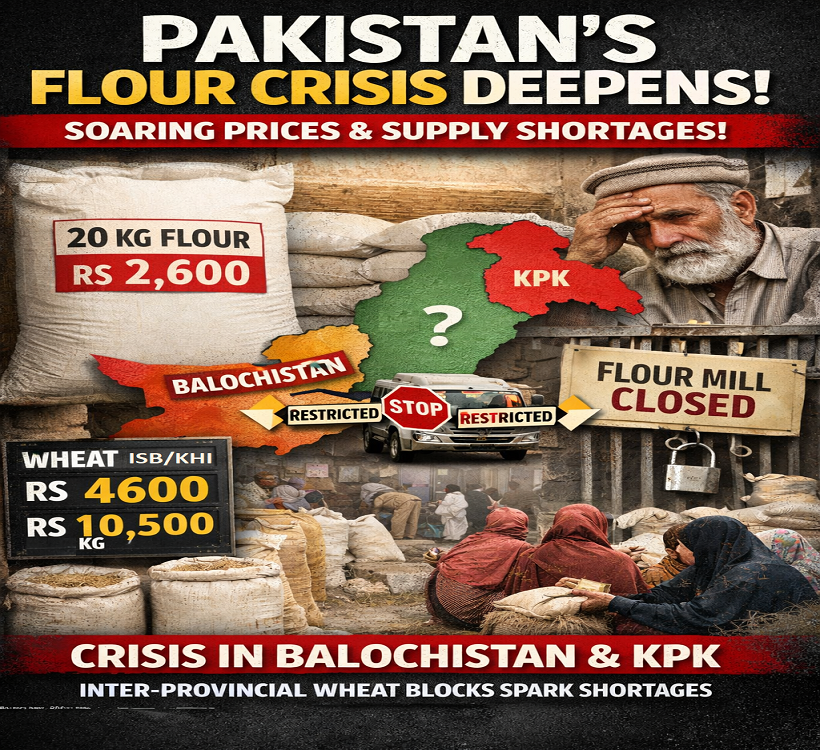
A severe flour crisis is unfolding across Pakistan, driving sharp price increases and raising serious concerns about food security — particularly in Balochistan and Khyber Pakhtunkhwa (K-P). The disruption in supply chains and restrictions on wheat movement have significantly impacted availability and affordability of this staple food.
📊 Current Price Situation Across Pakistan
Flour and wheat prices have surged nationwide over the past two weeks:
| Region | Price Level |
|---|---|
| Quetta | PKR 2,450 – 2,600 (20 kg bag) |
| Islamabad | PKR 4,600 per maund |
| Sindh | PKR 10,500 per 100 kg wheat |
| Peshawar | PKR 12,600 per 100 kg flour |
👉 This sharp rise reflects severe supply pressure and market imbalance.
🚫 Key Reason: Inter-Provincial Movement Restrictions
The primary driver behind the crisis is the restriction on inter-provincial movement of wheat and flour.
According to the Pakistan Flour Mills Association (PFMA):
- Distribution channels have been heavily disrupted
- Supply to deficit provinces has reduced significantly
- Market supply-demand balance has collapsed
👉 These restrictions are directly contributing to shortages in K-P and Balochistan.
⚠️ Khyber Pakhtunkhwa: Most Affected Region
The crisis is most severe in Khyber Pakhtunkhwa:
- Daily flour requirement: 130,000 bags
- Current supply from Punjab: ~20,000 bags/day
👉 This massive supply gap has created:
- Acute shortages
- Rapid price increases
- Panic buying in local markets
🏭 Flour Mills Shutdown & Supply Disruption
Due to limited wheat availability:
- 80% of flour mills in K-P have shut down
- Only 20% remain operational, relying on expensive and informal supply channels
👉 This has further tightened supply and increased production costs.
🌾 Structural Supply Gap in K-P
Khyber Pakhtunkhwa is structurally dependent on external supply:
- Annual wheat requirement: ~5 million tons
- Local production: ~1.4 million tons
- Shortfall covered by Punjab (≈75% of national production)
👉 Restrictions imposed since August 25 have severely disrupted this supply chain.
📉 Market Impact & Risk Analysis (Value Addition)
Immediate Impact:
- Rising flour prices
- Reduced availability in key regions
- Increased burden on low-income households
Medium-Term Risks:
- Worsening food insecurity
- Expansion of informal/smuggled supply channels
- Further shutdown of flour mills
👉 If the situation persists, the crisis could intensify, especially during high-demand periods.
🏛️ Industry Response & Government Recommendations
The PFMA has urged the government to take immediate action:
- Lift restrictions on wheat and flour movement
- Release government wheat stocks to K-P
- Form a joint committee to address industry challenges
👉 These measures are critical to restoring supply balance and controlling prices.
🔚 Conclusion
Pakistan’s ongoing flour crisis highlights the risks of supply chain disruptions in a food-sensitive market. While restrictions on wheat movement may be intended for price control, they are currently contributing to severe shortages in key regions. Immediate government intervention will be essential to stabilize the market, restore supply flows, and ensure food security for millions.
The Agri-Crop editorial team comprises commodity market analysts, rice trade specialists, and agriculture industry professionals based in Pakistan. We track daily price movements, export data, and policy developments across Pakistan’s key agricultural sectors.