
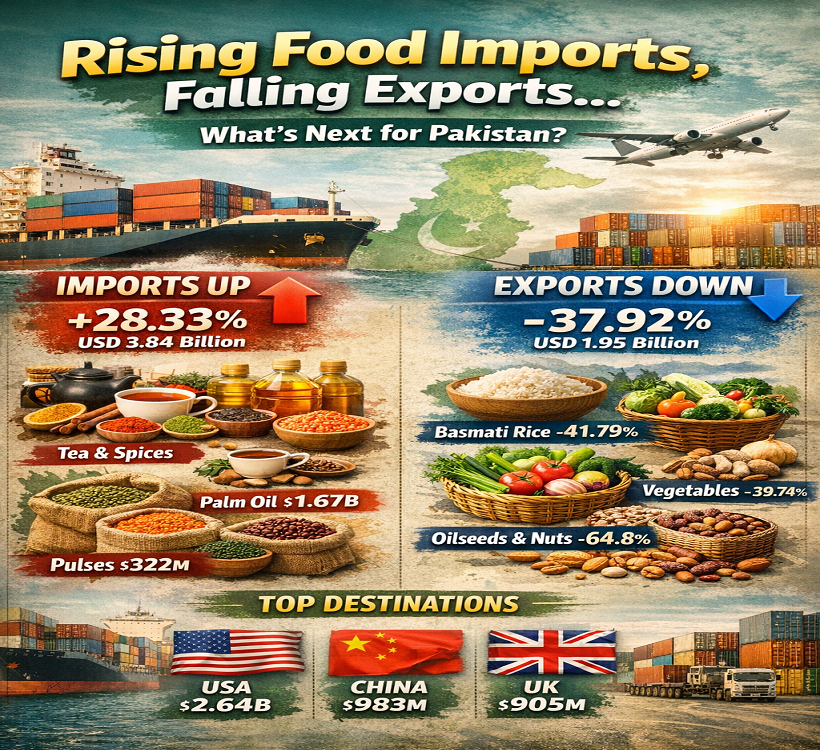
Pakistan’s food trade position has weakened during the first five months of FY2025–26, as imports increased sharply while exports contracted significantly, widening pressure on the external account.
📊 Overall Food Trade Position
- Food Imports: USD 3.84 billion
⬆️ +28.33% YoY (USD 2.998 billion last year) - Food Exports: USD 1.95 billion
⬇️ -37.92% YoY
👉 Result: Food trade balance has turned more negative, driven by rising edible oil and essential food imports alongside falling export performance.
📦 Key Import Breakdown
Pakistan’s import bill was led by essential commodities:
- 🫖 Tea: USD 261.5 million
- 🌴 Palm Oil: USD 1.676 billion (largest share)
- 🌶️ Spices: USD 100+ million
- 🫘 Soybean Oil: USD 68.8 million
- 🌾 Pulses: USD 322.8 million
- 🥜 Dry Fruits: USD 76.4 million
👉 Palm oil remains the single largest pressure point in the food import basket.
📉 Export Performance – Broad Weakness
Most major export categories recorded declines:
- 🍚 Basmati Rice: ⬇️ -41.79%
- 🌾 Non-Basmati Rice: ⬇️ -39.7%
- 🥦 Vegetables: ⬇️ -39.74%
- 🌰 Oilseeds & Nuts: ⬇️ -64.80%
- 🚬 Tobacco: ⬇️ -12.31%
📈 Limited Positive Growth:
- 🍎 Fruits: ⬆️ +13.08%
- 🐟 Fish & Seafood: ⬆️ +7.03%
👉 Export base remains concentrated, with only a few categories showing resilience.
🌍 Export Destinations
Top markets remained stable:
- 🇺🇸 United States: USD 2.639 billion ⬆️ +4.97%
- 🇨🇳 China: USD 982.98 million ⬇️ -6.84%
- 🇬🇧 United Kingdom: USD 904.90 million
⚖️ Market Insight
- Rising imports are driven by edible oil, tea, and pulses demand
- Export slowdown is led by rice, vegetables, and oilseeds
- Trade imbalance is widening despite growth in select export destinations
🔮 Outlook
👉 If current trends continue:
- Food import bill will remain elevated due to edible oil dependence
- Export earnings may stay under pressure unless rice and value-added food exports recover
- External account stress likely to persist in coming months
💡 Conclusion
Pakistan’s food sector is shifting toward a structural import dependency, especially in edible oils, while export weakness in traditional commodities like rice is limiting foreign exchange inflows.

The Agri-Crop editorial team comprises commodity market analysts, rice trade specialists, and agriculture industry professionals based in Pakistan. We track daily price movements, export data, and policy developments across Pakistan’s key agricultural sectors.