
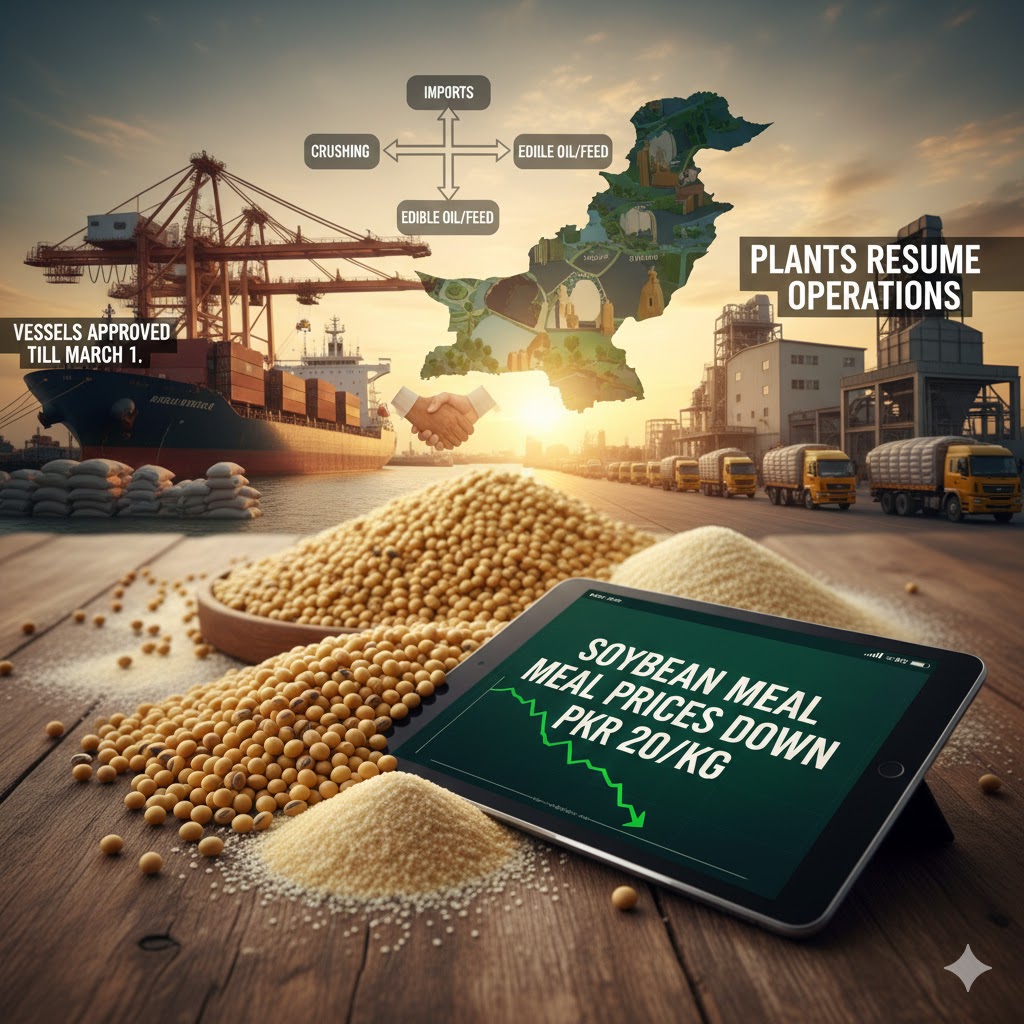
Pakistan has partially resolved the soybean seed import issue, allowing clearance for vessels that were previously stuck due to the absence of a pest risk assessment.
Approval has been granted for shipments arriving up to the first week of March, while consignments beyond that timeline remain under regulatory review.
📉 Immediate Market Reaction
The announcement triggered a sharp correction in soybean meal prices:
- Prices dropped by PKR 20/kg in a single day
➡️ Reflecting improved supply expectations and reduced uncertainty
This highlights how sensitive the feed market is to import policy changes.
🏭 Industry Impact
Before Approval:
- Import halt created uncertainty in edible oil & feed sectors
- Solvent plants explored alternative raw materials
- Risk of production slowdown and supply disruptions
After Approval:
- Confidence restored across the industry
- Crushing plants resumed normal operations
- Operational risks significantly reduced
🚢 Import Pipeline & Demand Outlook
Importers have already booked multiple soybean seed vessels through June, signaling:
- Strong demand from the crushing sector
- Expectation of continued import approvals
However, shipments arriving after early March are still uncertain, keeping the market cautious.
⚖️ Supply Chain Implications
If imports continue smoothly:
- Stable production of soybean oil and meal
- Balanced feed supply for poultry and livestock
- Controlled price environment
If restrictions return:
- Risk of supply shortages
- Increase in feed costs
- Potential rise in poultry (chicken) prices
🔮 Market Outlook
The market now expects the government to fully lift the import restriction to avoid further disruption.
Key factors to watch:
- Regulatory decisions on upcoming vessels
- Stock levels at crushing plants
- Arrival and clearance timelines
🔚 Conclusion
The partial resolution of Pakistan’s soybean import issue has brought immediate relief to the edible oil and feed sectors, reflected in falling soybean meal prices and improved industry confidence. However, long-term stability will depend on consistent import policies and timely regulatory approvals to support uninterrupted supply chains and price stability.

The Agri-Crop editorial team comprises commodity market analysts, rice trade specialists, and agriculture industry professionals based in Pakistan. We track daily price movements, export data, and policy developments across Pakistan’s key agricultural sectors.