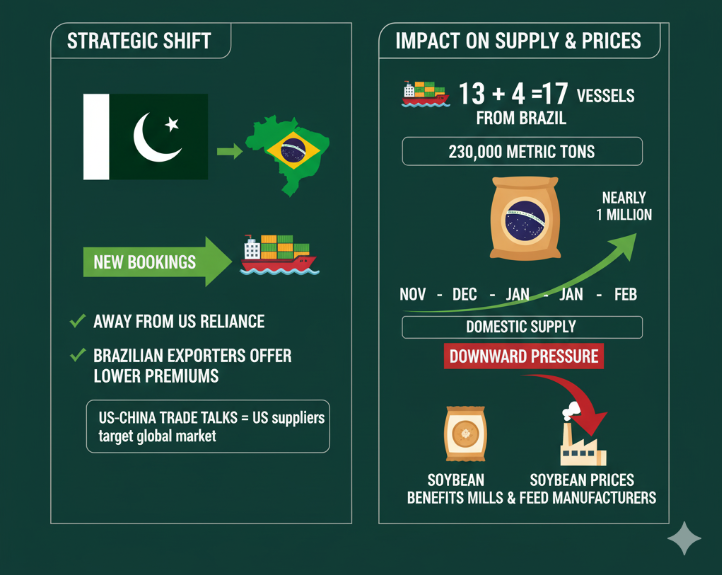
Pakistan’s soybean market is undergoing a strategic sourcing shift, with imports moving from the United States to Brazil, resulting in lower costs and stronger domestic supply availability.
🌍 Import Shift – Brazil Gains Advantage
🚢 New Buying Trend
- 🇧🇷 Brazil replacing 🇺🇸 United States as key supplier
- 💰 Reason: Lower export premiums from Brazil
👉 Global factor:
- 🇺🇸 U.S.–China trade dynamics influencing pricing
- 🌎 Brazil offering more competitive cargoes
📦 Shipment Bookings – Strong Pipeline
- 🚢 Total vessels booked: 17 (13 + 4 new)
- 📊 Volume: ~230,000 metric tons
👉 Supply outlook:
- 📦 Nov–Feb availability: ~1 million tons
⚖️ Market Impact – Supply Surge
📈 Key Effects
- 🏭 Higher crushing activity expected
- 📦 Improved raw material availability
- ⚖️ Reduced supply pressure in domestic market
📉 Price Outlook – Bearish for Soybean Meal
- 🐄 Soybean meal demand: steady (feed sector)
- 📦 Supply: sharply increasing
👉 Result:
- 📉 Downward pressure on soybean meal prices
- 🟢 Benefit for:
- Feed mills
- Poultry & livestock sector
🔄 Market Dynamics
| Factor | Impact |
|---|---|
| Import diversification | 🟢 Positive |
| Supply availability | 📈 Strong |
| Input costs | 📉 Declining |
| Feed industry margins | 📈 Improving |
🔮 Outlook
- 🟢 Short-term: oversupply conditions likely
- 📉 Prices: may soften further
- ⚠️ Risk factors:
- Currency fluctuations
- Global soybean price movement
- Freight cost changes
🔚 Conclusion
By increasing soybean imports from Brazil, Pakistan is securing cheaper supply and strengthening domestic availability. However, the resulting supply expansion is expected to put downward pressure on soybean meal prices, benefiting downstream industries while reshaping the local market balance.

The Agri-Crop editorial team comprises commodity market analysts, rice trade specialists, and agriculture industry professionals based in Pakistan. We track daily price movements, export data, and policy developments across Pakistan’s key agricultural sectors.