
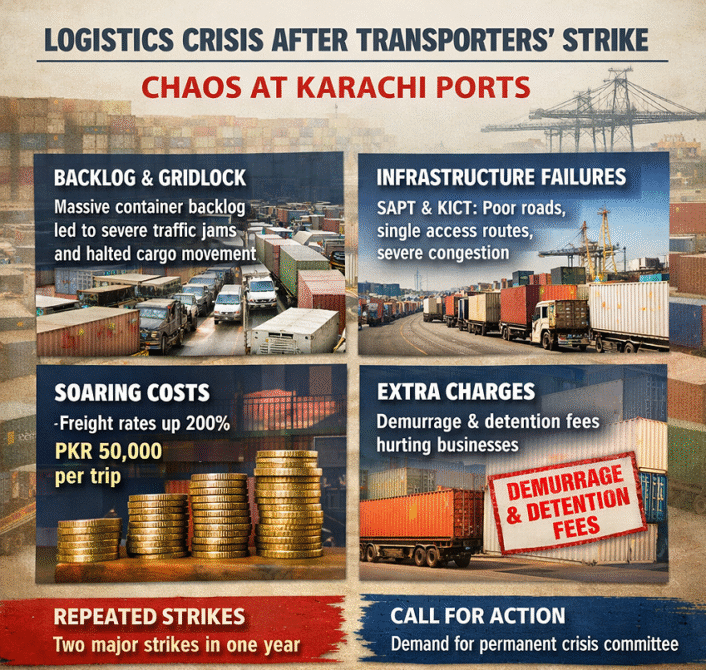
Although the 10-day transporters’ strike ended on 17 December, cargo movement at Karachi’s ports has not normalized. Instead, the situation has shifted into a logistics bottleneck crisis, exposing deep structural and operational weaknesses in Pakistan’s trade handling system.
📉 Current Situation – No Post-Strike Recovery
- 🚛 Cargo movement: Still heavily disrupted
- ⚓ Customs clearance: Operational
- 📦 Container handling at terminals: Functional
- 🚧 Road transport system: Collapsed under backlog pressure
👉 The core issue is no longer the strike, but infrastructure overload and poor traffic management.
🚦 Severe Urban & Port Congestion
Once released, accumulated containers overwhelmed the system:
- 🚫 Major gridlock across Karachi logistics corridors
- 📍 Worst-hit areas:
- Gulbai
- Maripur
- Port terminal access routes
👉 Result: Near paralysis of freight movement across key trade arteries
🏗️ Infrastructure Weak Points Exposed
⚓ SAPT Terminal (South Asia Pakistan Terminal)
- Single access road handling:
- Container trailers
- Residential traffic
- Public transport
- 👉 Creates chronic bottlenecks even in normal conditions
⚓ KICT (Karachi International Container Terminal)
- Poor road condition
- Weak traffic coordination
- Lack of structured flow management
👉 Overall system shows capacity constraints and planning gaps
💰 Economic Impact – Rising Logistics Costs
🚛 Freight Rate Surge
- Before: PKR 20,000 – 30,000
- After: PKR 40,000 – 50,000
- 📈 Increase: Up to 200%
👉 Transport cost inflation is now directly passing to:
- Importers
- Exporters
- Manufacturers
📦 Additional Financial Pressure
- ⚠️ Rising demurrage & detention charges
- ⚠️ Delayed container clearance costs
- ⚠️ Increased operational burden on traders
👉 Businesses are facing a multi-layered cost escalation shock
⚠️ Structural Issue – Repeated Disruptions
Industry stakeholders highlight a critical concern:
- 🚨 Two major transport strikes in a single year
- 📉 Repeated paralysis of logistics chain
- 🤝 Weak coordination between stakeholders
👉 Core issue identified as:
- Lack of government–industry consultation
- Absence of preventive dispute resolution mechanism
🏛️ Industry Recommendation
Stakeholders are calling for a permanent consultative body including:
- Government departments
- Karachi Customs Agents Association (KCAA)
- FPCCI
- Chambers of commerce
- Transporter associations
👉 Objective:
- Prevent disruptions before escalation
- Ensure continuous trade flow
- Reduce recurring economic losses
🔮 Outlook
- Short-term: Congestion likely to persist until backlog clears
- Medium-term: Freight costs may stabilize at higher level
- Long-term risk: Structural inefficiencies may keep logistics expensive
💡 Conclusion
Pakistan’s port crisis is no longer event-driven (strike-based), but has evolved into a systemic logistics capacity and coordination problem, where infrastructure limits and weak governance are now directly increasing trade costs and disrupting export/import flow.

The Agri-Crop editorial team comprises commodity market analysts, rice trade specialists, and agriculture industry professionals based in Pakistan. We track daily price movements, export data, and policy developments across Pakistan’s key agricultural sectors.