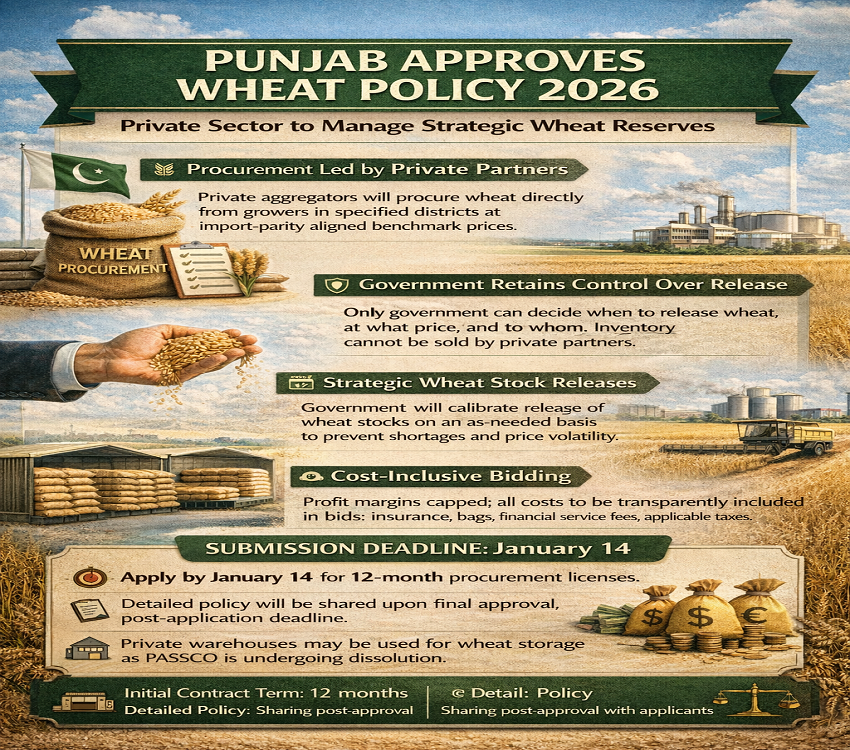
The government has held a detailed meeting to brief stakeholders on a new Public–Private Partnership (PPP) framework under which the private sector will play a central role in managing strategic wheat reserves.
Under this model, private participants will handle procurement, financing, storage, maintenance, and supply operations, while the government retains full control over pricing and release decisions.
⚙️ How the PPP Model Will Work
Authorities clarified that this is strictly a service-based arrangement, not a free-market trading model.
👉 Key principle:
- Private partners cannot sell wheat independently
- Government will decide:
- When to release wheat
- At what price
- To which buyers
➡️ This ensures centralized control over food security and price stability.
🌾 Procurement Process & Farmer Pricing
Private partners will be directed to procure wheat directly from farmers in designated districts.
💰 Pricing Mechanism:
- Based on import-parity benchmark
- Linked to prevailing market conditions during procurement window
👉 This approach aims to:
- Provide fair returns to farmers
- Align local prices with global market trends
📦 Controlled Wheat Release Strategy
To protect consumers, the government will release wheat stocks in a calibrated manner:
- On an as-needed basis
- Focus on high-demand periods:
- Winter season
- Ramadan
👉 Objective:
- Prevent artificial shortages
- Control hoarding
- Reduce price volatility
📊 Contract Terms & Private Sector Incentives
- Initial contract duration: 12 months
- Profit margins:
- Capped
- Determined through competitive bidding (monthly/quarterly)
👉 This ensures:
- Fair competition
- Controlled profitability
- Cost efficiency for government
💼 Cost Structure Transparency (Important Reform)
Private participants must include all costs in their bids:
- Insurance (inventory risk on purchaser)
- Bagging/packaging costs
- Financial service charges
- Applicable taxes
👉 This improves transparency and accountability in the system.
🏢 Storage & PASSCO Transition
The meeting also highlighted a major structural shift:
- PASSCO is being dissolved
- Its storage facilities may not remain available
👉 As a result:
- Private warehouses will be used for storing strategic wheat reserves
➡️ This marks a significant move toward private-sector-led infrastructure.
📅 Application Deadline & Next Steps
- Application deadline: January 14
- Only approved applicants will receive procurement licenses
The detailed policy is currently under development and will be shared after formal approval.
📉 Market Impact & Analysis (Value Addition)
✅ Potential Benefits:
- Reduced government operational burden
- Improved efficiency via private sector involvement
- Better supply chain management
- Increased transparency in costing
⚠️ Potential Risks:
- Dependence on private players
- Execution challenges during transition
- Pricing sensitivity linked to global markets
🔚 Conclusion
The introduction of a PPP-based wheat procurement model represents a major shift in how strategic wheat reserves will be managed. By combining private sector efficiency with government control over pricing and distribution, the framework aims to balance market dynamics with food security. However, its success will depend on transparent implementation and effective monitoring.
The Agri-Crop editorial team comprises commodity market analysts, rice trade specialists, and agriculture industry professionals based in Pakistan. We track daily price movements, export data, and policy developments across Pakistan’s key agricultural sectors.