
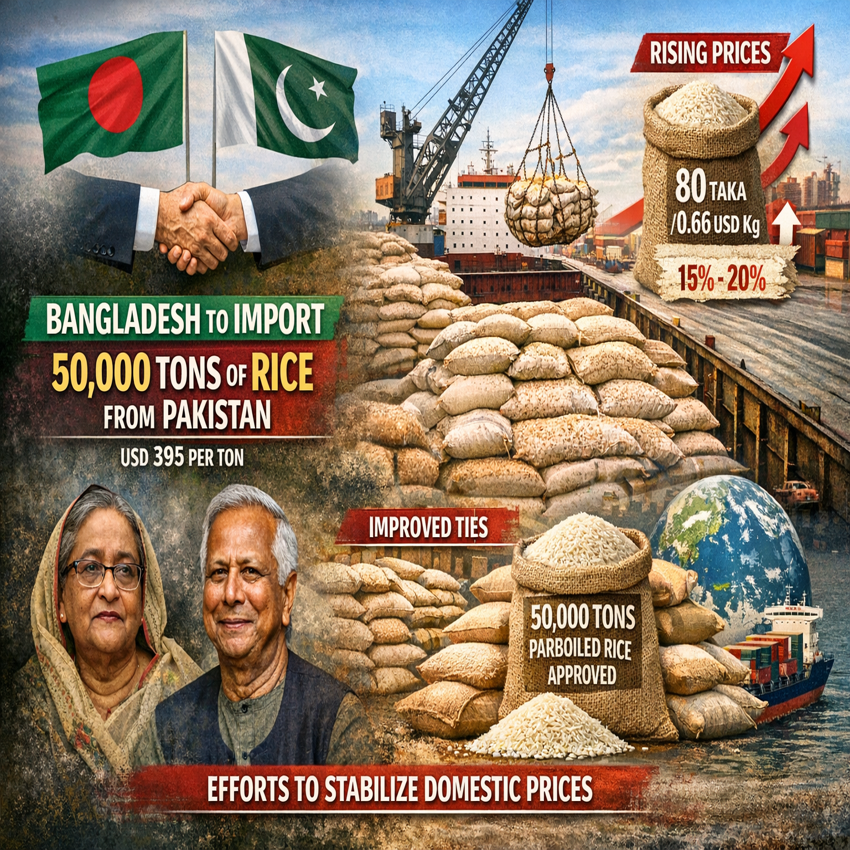
Bangladesh has approved another significant rice import from Pakistan. The Cabinet Committee on Government Purchase cleared a 50,000 metric ton deal at USD 395 per ton under a government-to-government agreement. The purchase aims to stabilize domestic rice prices, which have surged between 15% and 20% in recent months. Moreover, it marks another milestone in a rapidly growing bilateral trade relationship that carries deep historical significance.
The Deal: Price, Volume, and Approval
Bangladesh’s Cabinet Committee on Government Purchase approved this latest rice import deal on Tuesday. The agreement covers 50,000 metric tons of white rice from Pakistan, priced at USD 395 per ton.
That price point is notably lower than Bangladesh’s previous purchase from Pakistan. In February this year, Bangladesh imported 50,000 metric tons of Pakistani rice at USD 499 per ton under a similar G2G arrangement. The USD 104 per ton reduction reflects both improved supply conditions and Pakistan’s efforts to price competitively in a softening global rice market.
Alongside the Pakistani rice deal, the Bangladeshi government also approved the purchase of an additional 50,000 metric tons of parboiled rice through an international tender. Together, these two approvals form part of a broader, coordinated import strategy aimed at easing supply pressure and cooling persistently high domestic food prices.
Why Bangladesh Needs to Import: A Domestic Price Crisis
Bangladesh is not importing rice by choice. It is importing out of urgent necessity.
Domestic rice prices in Bangladesh have climbed 15% to 20% in recent months. Medium-grade rice — the staple for millions of Bangladeshi households — is currently selling at around 80 taka, or USD 0.66, per kilogram. For low- and middle-income families, that price increase represents a serious strain on household budgets.
The Bangladesh government has already taken steps to ease the supply crunch. It removed import duties on rice to encourage faster procurement from international markets. Despite that intervention, however, staple food prices have remained persistently high. The duty removal alone has not been sufficient to bring prices down to comfortable levels.
Consequently, the government is pursuing direct import agreements — both through G2G channels and international tenders — to inject additional supply into the market and break the price pressure that domestic consumers are experiencing.
A Historic Trade Relationship Reborn
What makes this deal particularly significant goes beyond rice pricing and supply logistics. It represents the continuation of a historic trade revival between two countries that had not traded directly in rice since Bangladesh’s independence in 1971 — over five decades ago.
Earlier this year, Bangladesh and Pakistan resumed direct rice trade for the first time since that historic break. The February 2025 deal — covering 50,000 metric tons at USD 499 per ton — broke more than 50 years of trade silence between Dhaka and Islamabad. This latest agreement builds on that foundation and confirms that the February deal was not a one-off transaction. Rather, it was the opening of a sustained and growing trade relationship.
For Pakistan’s rice export sector, that matters enormously. G2G agreements provide stability and predictability that spot market deals cannot offer. Each successful delivery strengthens trust, and each new agreement opens the door to larger volumes in the future.
Diplomacy Behind the Deal: Yunus Government Opens New Doors
The revival of Bangladesh-Pakistan rice trade did not happen by accident. It is the direct result of improved diplomatic relations between the two countries — a shift driven largely by political change in Dhaka.
An interim government led by Nobel laureate Muhammad Yunus assumed power in Bangladesh following mass protests that forced former Prime Minister Sheikh Hasina to leave the country. The Yunus-led administration brought a new foreign policy orientation — one more open to diversifying Bangladesh’s trade relationships and engaging with partners that previous governments had kept at arm’s length.
Pakistan and Bangladesh share a complex historical relationship. Diplomatic and trade ties had remained limited for decades. However, the change in Bangladeshi leadership created an opening, and both governments moved quickly to activate it through practical trade cooperation.
The rice trade is, in many ways, a tangible expression of that diplomatic thaw. Furthermore, it demonstrates how political shifts can unlock economic opportunities that had been dormant for generations.
What This Means for Pakistan’s Rice Exporters
For Pakistan, this deal arrives at a critical moment. Rice exports are running approximately 46% below last year’s levels during the current fiscal year. The country is competing in a global market where India offers aggressive pricing and global demand has softened from last year’s stockpiling-driven peak.
Against that backdrop, the Bangladesh G2G channel is delivering consistent, reliable volume that Pakistan’s exporters urgently need.
Consider the trajectory. Pakistan supplied 50,000 metric tons to Bangladesh in February at USD 499 per ton. It then won a competitive 100,000 metric ton tender with a winning bid of USD 394.98 per ton. Now, another 50,000 metric ton deal has cleared at USD 395 per ton. In total, Pakistan has secured approximately 200,000 metric tons of rice orders from Bangladesh within a single year — a remarkable acceleration of bilateral trade.
Moreover, Pakistan is demonstrating price competitiveness within these tenders. In the 100,000-ton tender, Jhulay Lal Company submitted the lowest bid among eleven competitors — winning the contract on price. That kind of competitive performance in open bidding builds Pakistan’s reputation as a reliable, cost-effective supplier.
Bangladesh’s Broader Import Strategy
It is important to understand this deal within Bangladesh’s wider import plan. The government is not relying on Pakistan alone to solve its supply problem.
Bangladesh has set a rice import target of close to 900,000 metric tons for this year — a direct response to the consecutive floods that wiped out more than 1 million metric tons of domestic rice production last fiscal year. To meet that target, Dhaka is actively diversifying its import sources across multiple countries and procurement channels.
The simultaneous approval of the Pakistani G2G deal and the 50,000-ton international parboiled rice tender illustrates that diversification strategy in action. Bangladesh is buying from Pakistan through direct government agreements while simultaneously running open tenders to source from other suppliers.
This approach serves Bangladesh well — it ensures supply security without overdependence on any single exporter. For Pakistan, it means the competition for future Bangladeshi orders will remain active. Maintaining price competitiveness and reliable delivery is essential to keeping Pakistan’s position secure in Bangladesh’s import rotation.
Outlook: More Orders Could Follow
The momentum behind Bangladesh-Pakistan rice trade is building steadily. Three G2G deals within a single year — covering a combined 200,000 metric tons — establish Pakistan as a genuine pillar of Bangladesh’s import strategy.
If Pakistan delivers on time and maintains competitive pricing, Bangladesh will almost certainly return for additional orders. The country still needs to import large volumes to stabilize domestic prices, and its government has shown a clear preference for G2G arrangements that offer speed and reliability over open-market procurement.
For Pakistan’s rice sector, the lesson is clear. Building and maintaining strong G2G relationships — with Bangladesh and other food-importing nations — offers a sustainable path to export volume growth even when global spot market conditions are difficult. The diplomatic groundwork has been laid. The commercial track record is forming. Pakistan now needs to execute consistently and pursue similar agreements across other markets.

The Agri-Crop editorial team comprises commodity market analysts, rice trade specialists, and agriculture industry professionals based in Pakistan. We track daily price movements, export data, and policy developments across Pakistan’s key agricultural sectors.