Pakistan’s domestic rice market is showing clear signs of stability. Strong export demand is the main force keeping prices firm. Traders remain active, shipments are moving, and the market is holding its ground heading into the post-harvest period.
IRRI-6 Prices Edge Higher
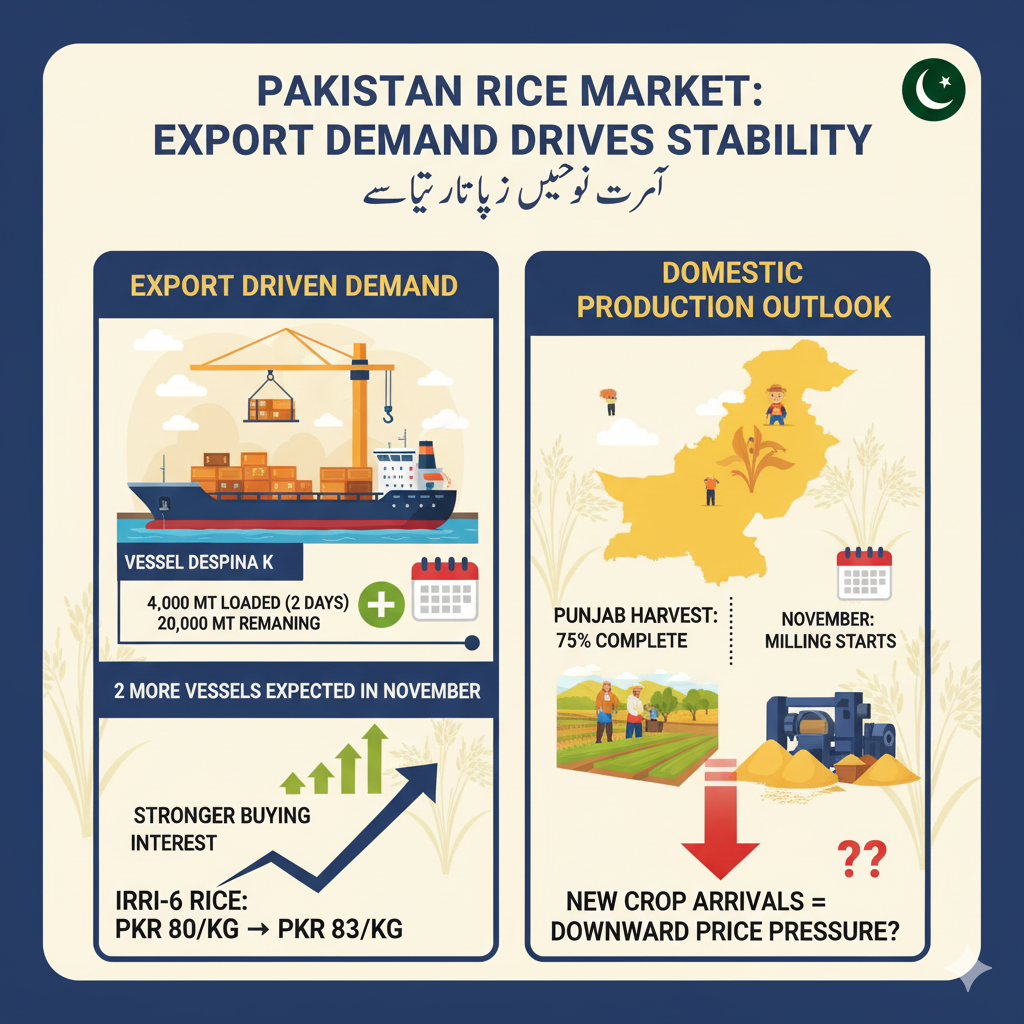
IRRI-6 is one of Pakistan’s most exported rice varieties. Buyers worldwide prefer it for its consistent quality and competitive price. Recently, its rate climbed from PKR 80 per kg to PKR 83 per kg.
This gain reflects a real shift in market conditions. Export orders are pulling stock out of the domestic market. That reduces available supply. Sellers gain more pricing power as a result. For millers and traders, this upward movement — even if gradual — confirms that demand is healthy and active.
Vessel Despina K: Loading in Progress
Export activity at Pakistan’s ports is brisk. The vessel Despina K is currently at port and loading rice for international delivery.
Here is where things stand:
- Loaders have already shipped 4,000 metric tons onto the vessel.
- 20,000 metric tons remain and will load in the coming days.
- Operations began on November 3.
- The team loaded 4,000 tons in just two days — a fast and efficient pace.
The total cargo for this single shipment reaches approximately 24,000 metric tons. That is a substantial volume. It absorbs a significant portion of domestic supply and directly supports current price levels.
Two More Vessels Expected in November
The Despina K is not the only story. Market sources confirm that two additional vessels will load during November. This signals that export momentum is building, not slowing.
This matters for three reasons:
- Demand is sustained. Multiple vessel bookings in one month show that overseas buyers — likely from Africa, the Middle East, or Asia — continue to rely on Pakistani rice.
- Traders stay confident. The expectation of continued export orders keeps traders buying in the domestic market. That consistent demand supports prices.
- The market stays firm. Active buyers on both ends reduce the risk of a sudden price drop.
For Pakistan’s rice sector, this level of export activity during the post-harvest season is a strong positive signal.
Punjab Harvest: 75% Done, But Market Impact Delayed
Punjab is Pakistan’s largest rice-producing province. The harvest there is nearly complete. Farmers have brought in roughly 75% of the crop so far.
However, most of this rice is still in paddy form. It has not yet gone through milling. Millers will process it during November. Only after milling does it enter the market as sellable rice.
What Happens When the Rice Hits the Market?
A large volume of newly milled rice entering the market will likely push prices lower. More supply without a matching rise in demand creates downward pressure. This is basic market economics.
Traders need to watch this closely. The speed of paddy conversion will determine how much supply hits the market — and how quickly. A slow release may allow exports to absorb the new stock. A fast release could tip the balance and trigger a price correction.
The Balancing Act Ahead
The next few weeks will test the market’s ability to stay stable. Two forces are pulling in opposite directions.
On one side, export demand is strong. Vessel loading is active. Buyers are engaged.
On the other side, a large supply of newly milled rice is about to enter the market.
Three questions will shape the outcome:
- How fast will millers convert paddy and release rice to the market?
- Will export demand keep pace with the new supply?
- Will additional vessel bookings arrive beyond November’s two expected ships?
If exports absorb the incoming supply, prices may hold or even rise further. If supply outpaces exports, a price correction in December becomes likely.
Outlook: Cautious But Positive
The overall picture for Pakistan’s rice market is one of cautious optimism. Export demand is real. Shipments are moving. Prices are holding firm.
At the same time, a period of rising supply is approaching. Farmers, millers, traders, and exporters all need to stay alert. Watching export booking news and the pace of paddy milling will be key to making smart decisions.
Pakistan’s rice sector has shown real resilience this season. If export momentum holds, the market is well-placed to handle the incoming supply wave.

The Agri-Crop editorial team comprises commodity market analysts, rice trade specialists, and agriculture industry professionals based in Pakistan. We track daily price movements, export data, and policy developments across Pakistan’s key agricultural sectors.