
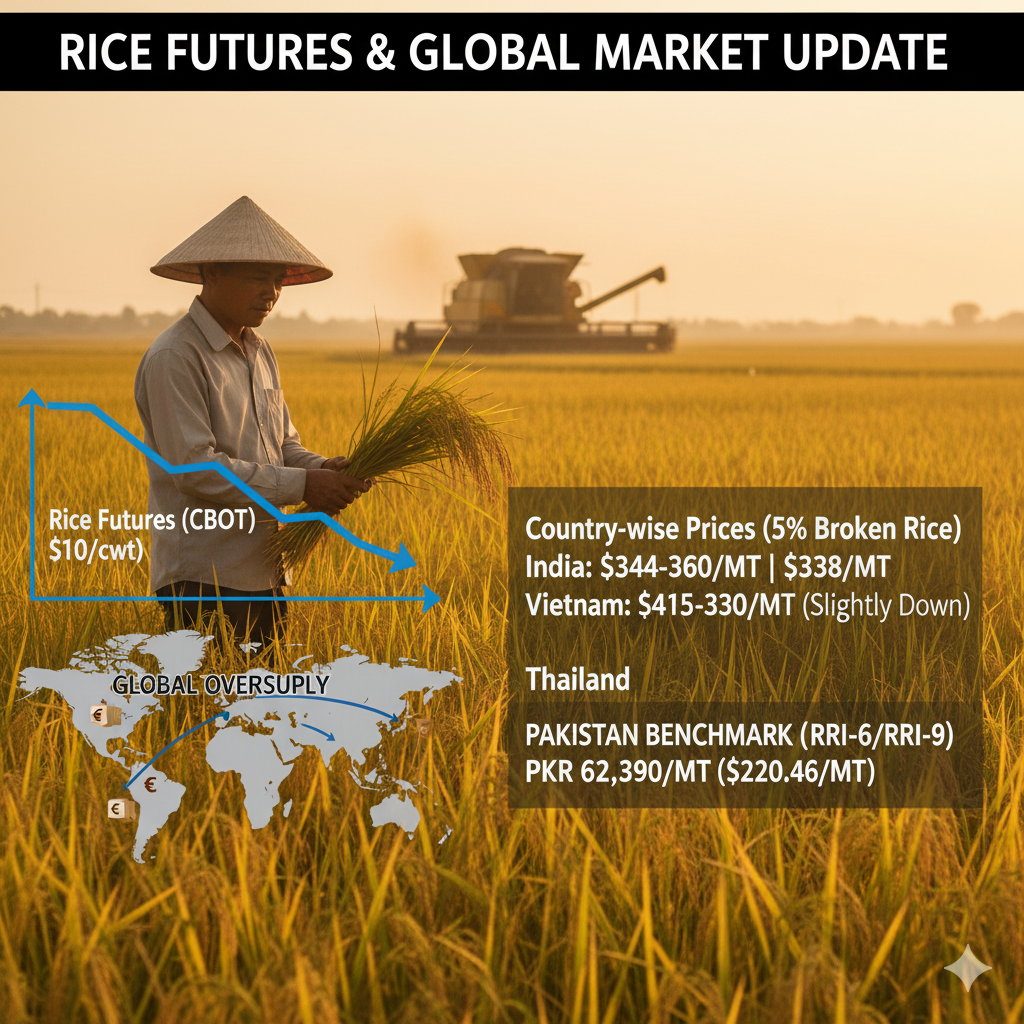
Global rice prices are under pressure. Ice futures are trading just below $10 per cwt — the lowest level since September 2018. Oversupply fears are driving the decline, and buyers worldwide are pulling back. This article breaks down the numbers, explains the global supply picture, and outlines what it means for Pakistan’s rice exporters.
Futures Hit a Six-Year Low
Rice futures have not been this low in over six years. The last time prices touched this level was September 2018. That context matters. It tells us this is not a minor dip — it is a significant market shift.
Global oversupply is the core reason. Bumper harvests across major Asian exporters have flooded the market with supply. Stocks in China, Thailand, Indonesia, and Vietnam are all elevated. India’s harvest has been particularly strong this season. Together, these factors have kept supply abundant and buyers cautious.
Demand has not kept pace. Buyers are taking a measured approach to procurement. They are not rushing. They know supply is plentiful and prices may fall further. That mindset is keeping demand subdued and putting additional pressure on prices.
Record Global Production in 2025–26
The United Nations Food and Agriculture Organization (FAO) has released its latest forecast. Global rice production will reach a record 556.4 million tons in 2025–26. That surpasses every previous year on record.
This forecast amplifies the oversupply concern. When buyers know a record crop is coming, they delay purchases. They wait for prices to fall further. That behavior reduces near-term demand and reinforces the downward price trend we are seeing in futures markets right now.
CBOT Futures: What the Numbers Mean for Pakistan
Understanding CBOT Rough Rice futures is essential for anyone in Pakistan’s rice trade. Here is a clear breakdown of the current pricing.
CBOT Rough Rice futures (U.S. No. 2) are currently trading at $10 per cwt (per hundredweight).
To convert this to metric tons, we use the standard conversion factor of 22.046:
$10 × 22.046 = $220.46 per metric ton (USD/MT)
Now convert to Pakistani Rupees using the current exchange rate of PKR 283 per USD:
$220.46 × 283 = PKR 62,390 per metric ton
This benchmark price is most relevant for Pakistan’s non-aromatic, medium- to long-grain varieties — specifically IRRI-6 and IRRI-9. These are Pakistan’s primary export rice types competing in the global commodity market.
Why This Benchmark Matters
CBOT futures serve as a global reference point. When futures prices move, local paddy prices in Pakistan must follow. If they do not, Pakistan loses its price competitiveness in international markets.
Exporters and millers should track CBOT movements closely. Any significant drop in futures should translate into adjusted local paddy prices. Failing to do so risks pricing Pakistani rice out of the market — particularly when competitors like India, Vietnam, and Thailand are already offering lower rates.
Country-by-Country Price Comparison: 5% Broken Rice
Here is where Pakistan’s key competitors stand on pricing for 5% broken rice:
| Country | Variety | Price (USD/MT) |
|---|---|---|
| India | Parboiled | $344–$350 |
| India | White | $350–$360 |
| Thailand | White | $338 (down from $340 last week) |
| Vietnam | White | $415–$430 |
A few things stand out from this data.
India is the most competitive major exporter. Its parboiled rice starts at just $344/MT. White rice sits between $350–$360/MT. These are aggressive price points that put pressure on all competing exporters.
Thailand has edged lower. Prices slipped from $340 to $338/MT this week. That is a small move, but it signals a softening trend. Thailand is adjusting to compete as supply builds.
Vietnam is the outlier. At $415–$430/MT, Vietnam remains the most expensive among the major exporters. That premium likely reflects quality and contract commitments. However, Vietnam’s pricing may come under pressure as its harvest expands.
India: Dry Weather Accelerates Harvest
Market reports confirm that paddy harvesting in India is gaining momentum. Dry weather across key growing regions is allowing farmers to harvest quickly and efficiently. Faster harvesting means more supply reaches the market sooner. That adds to the existing pressure on prices.
India’s competitive pricing reflects this supply confidence. With a strong crop coming in, Indian exporters can afford to offer lower rates and still maintain healthy margins.
Vietnam: A Market in Transition
Vietnam is in the early stages of its Mekong Delta harvest. This is one of the most productive rice-growing regions in Southeast Asia. As that harvest progresses, it will add more supply to the market and push modest downward pressure on prices.
However, Vietnam’s export data tells a more complex story.
In October, Vietnam’s rice exports fell 56.2% year-on-year — dropping to just 344,000 tons. That is a sharp decline from the same month last year.
For the period January through October, total exports stood at 7.17 million tons — down 7.5% year-on-year.
These numbers suggest Vietnam is managing its export pace carefully. Its government has historically intervened in rice exports to protect domestic food security. The October drop may reflect such controls, contract timing issues, or a pullback in overseas demand.
Despite lower export volumes, Vietnam’s prices remain the highest among major exporters. That gap between pricing and volume is worth watching as the Mekong harvest develops.
What This Means for Pakistan
Pakistan’s rice exporters face a challenging environment. Global prices are at a six-year low. Record production forecasts are keeping buyers cautious. Competitors are adjusting prices aggressively.
To stay competitive, Pakistan must:
- Track CBOT futures daily. Local paddy prices must reflect global benchmark movements.
- Monitor India closely. India sets the price floor for non-aromatic rice in most markets. Pakistan’s IRRI-6 and IRRI-9 must remain competitively priced relative to Indian alternatives.
- Watch Vietnam’s harvest progress. As the Mekong Delta harvest ramps up, additional supply pressure will build. This could push global prices even lower in the short term.
- Adjust procurement strategies. Buyers are already taking a measured approach. Offering flexible contract terms and reliable delivery timelines can help Pakistani exporters stand out.
Outlook: Pressure Will Persist in the Near Term
The global rice market faces continued downward pressure. Record production, elevated stocks, and cautious buyers form a difficult combination. Prices may test new lows before finding a floor.
For Pakistan, the key is responsiveness. Local prices must align with global benchmarks. Exporters who stay ahead of this adjustment will protect their market share. Those who lag behind risk losing buyers to more aggressive competitors.
The market is challenging — but it rewards those who read it clearly and act quickly.

The Agri-Crop editorial team comprises commodity market analysts, rice trade specialists, and agriculture industry professionals based in Pakistan. We track daily price movements, export data, and policy developments across Pakistan’s key agricultural sectors.