
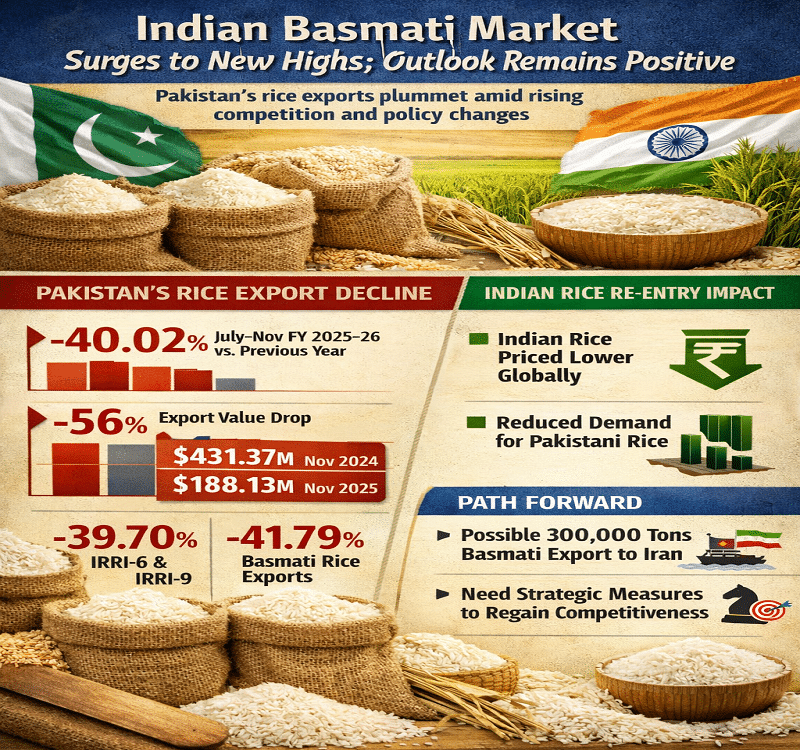
Pakistan’s rice export sector is facing one of its most difficult periods in recent history. A sharp 40% decline in export volumes during the first five months of FY2025–26 reflects a combination of intensifying international competition and damaging domestic policy changes. The shift from the Final Tax Regime to the Normal Tax Regime has restructured exporters’ costs in ways that have directly undermined Pakistan’s price competitiveness. Meanwhile, India’s return to global rice markets has hit Pakistan’s exports hard across both Basmati and non-Basmati categories. This article examines the data, explains the causes, and outlines what Pakistan must do to recover.
The Numbers: A 40% Volume Drop and a 56% Revenue Collapse
The Pakistan Bureau of Statistics has released export data for July through November of FY2025–26. The figures paint a stark picture.
Pakistan’s overall rice export volumes fell by 40.02% year-on-year during this five-month period. Breaking that down by category reveals that both major rice types suffered significant declines.
Non-Basmati rice — primarily IRRI-6 and IRRI-9 — recorded a 39.70% drop in export volumes. These varieties form the backbone of Pakistan’s high-volume commodity rice trade, so a decline of this magnitude removes enormous tonnage from the export pipeline.
Basmati rice — Pakistan’s premium aromatic variety — fell even more sharply, declining by 41.79%. That is a particularly painful result because Basmati generates significantly higher revenue per ton than non-Basmati varieties. Losing Basmati volume hurts Pakistan’s export earnings disproportionately.
The revenue impact reflects both the volume decline and the lower prices prevailing in global markets. Pakistan’s rice export revenue in November 2025 stood at $188.13 million — a collapse of 56% compared to $431.37 million in November 2024. In other words, Pakistan earned barely half of what it generated from rice exports just one year ago.
The Tax Regime Change: A Self-Inflicted Wound
International competition alone does not explain Pakistan’s export decline. A significant portion of the damage is self-inflicted — the direct result of a domestic policy change that fundamentally altered the economics of rice exporting.
Pakistan shifted its rice export sector from the Final Tax Regime (FTR) to the Normal Tax Regime (NTR). Under the FTR, exporters paid a fixed withholding tax as their final tax liability. The system was simple, predictable, and kept compliance costs low. Under the NTR, exporters must now calculate and pay tax on their actual profits — exposing them to higher effective tax rates, increased compliance burdens, and greater uncertainty around their annual tax liability.
For an industry operating on thin margins in a price-competitive global market, that change is devastating. Rising production costs flow directly into the export price that Pakistani sellers must quote to international buyers. When Pakistan’s quote rises and India’s stays flat or falls, buyers make a straightforward decision. They buy Indian rice.
The FTR-to-NTR transition has effectively imposed a structural cost disadvantage on every Pakistani rice exporter. Until the government addresses this policy change — either by reversing it or introducing targeted relief measures — Pakistan’s exporters will continue operating at a disadvantage against lower-cost competitors.
India’s Return: The External Pressure That Compounds the Problem
While Pakistan dealt with its domestic tax shock, India removed its own rice export restrictions and returned aggressively to global markets. The timing could not have been worse for Pakistani exporters.
India is the world’s largest rice exporter. Its return to unrestricted exporting flooded global markets with competitively priced supply. Indian non-Basmati rice undercuts Pakistani IRRI varieties in most major import markets. Furthermore, Indian Basmati — traditionally priced below Pakistani Super Basmati — continues to attract price-sensitive premium buyers who might otherwise consider Pakistani alternatives.
The combination of India’s volume and pricing has reshaped the competitive landscape in virtually every market where Pakistan sells rice. African buyers, Middle Eastern importers, and Asian procurement agencies all now have access to abundant Indian supply at prices that Pakistani exporters struggle to match.
Experts confirm that India’s re-entry is the primary external driver of Pakistan’s export decline. Nevertheless, it is important to distinguish between factors Pakistan can control and those it cannot. India’s pricing and production decisions are beyond Pakistan’s influence. The domestic tax regime is not.
One Bright Spot: A Potential 300,000-Ton Basmati Deal via Iran
Amid the difficult data, one development offers meaningful relief. Reports indicate that approximately 300,000 metric tons of Basmati rice could be exported from Pakistan through Iran.
If confirmed, that would represent a significant volume boost for Pakistan’s Basmati export program. Iran has historically been one of Pakistan’s most important Basmati markets, and a deal of this scale would partially offset the revenue lost to the broader export decline.
However, the Iran channel carries real risks. The Iranian rial’s sharp depreciation has complicated payment arrangements for Pakistani exporters. Import approval delays from the Iranian government have disrupted previous shipments. Additionally, ongoing geopolitical tensions in the region add uncertainty around shipment logistics and payment security.
Therefore, while the 300,000-ton opportunity is genuinely encouraging, exporters should approach it with careful contract structuring and payment risk mitigation. A deal that gets stuck in transit or faces payment default would compound — rather than ease — the sector’s current difficulties.
Basmati’s Premium Is Under Threat
Pakistan’s Basmati rice commands a significant price premium in global markets. Currently, Pakistani Basmati trades at around $1,200 per ton, while Indian Basmati fetches approximately $900 per ton. That $300 per ton gap reflects the genuine quality difference between the two products — Pakistani Super Basmati’s distinctive aroma and grain quality justify a premium among discerning buyers.
However, that premium is not unlimited. As Indian Basmati improves in quality and remains aggressively priced, some buyers who previously paid the Pakistani premium are reconsidering. If the price gap widens further — due to Pakistan’s rising domestic costs — more premium buyers may shift toward Indian Basmati, accepting a modest quality trade-off for a substantially lower price.
Protecting the Basmati premium requires active investment in quality certification, international marketing, and geographical indication protection. Pakistan cannot assume that quality alone will sustain buyer loyalty indefinitely when a $300 price difference sits between the two options.
What Pakistan Must Do to Recover Competitiveness
The path back to competitive rice exports requires action on several fronts simultaneously.
Address the NTR impact urgently. The government must recognize that the FTR-to-NTR transition has directly damaged export competitiveness. Targeted relief — whether through export rebates, reduced withholding rates, or a sector-specific tax structure — can partially restore the cost advantage that Pakistani exporters have lost.
Reduce the overall cost of exporting. Beyond taxation, energy costs, financing rates, and logistics charges all contribute to Pakistan’s cost disadvantage. Cheaper export financing, subsidized mill energy tariffs, and streamlined port procedures can each contribute meaningfully to closing the price gap with Indian competitors.
Pursue G2G agreements aggressively. The Bangladesh deals have demonstrated that government-to-government trade provides reliable volume at negotiated prices — insulating Pakistani exporters from some of the spot market pressure created by Indian competition. Pakistan should replicate that model across Africa, the Middle East, and Central Asia.
Invest in Basmati branding and protection. Pakistan’s Super Basmati premium is a strategic asset. Geographical indication status, international quality certification, and targeted marketing campaigns in high-value markets — Europe, North America, and the Gulf — can strengthen buyer loyalty and justify the price premium against Indian alternatives.
Diversify away from price-sensitive commodity markets. In markets where buyers choose purely on price, Pakistan will struggle to beat India consistently. Consequently, Pakistani exporters should focus more energy on premium and niche markets where quality differentiation matters more than absolute price.
Outlook: The Crisis Is Solvable, But Action Is Urgent
Pakistan’s rice export decline is serious — but it is not irreversible. The fundamental assets remain intact. Pakistan grows world-class Basmati. It has established trade relationships across dozens of markets. It has the milling capacity and logistics infrastructure to export at scale.
What it lacks right now is price competitiveness — and that competitiveness is recoverable through the right combination of domestic policy reform and strategic market positioning.
However, time matters. Every month that Pakistan exports at half its previous pace, buyers build deeper relationships with Indian and Vietnamese suppliers. Recovering lost market share becomes harder the longer the decline persists.
The government and the rice industry need to treat this as the economic emergency it is. A USD 1.5 billion drop in annual export earnings, combined with a 56% revenue collapse in a single month, demands an urgent, coordinated response — not gradual adjustment.

The Agri-Crop editorial team comprises commodity market analysts, rice trade specialists, and agriculture industry professionals based in Pakistan. We track daily price movements, export data, and policy developments across Pakistan’s key agricultural sectors.