
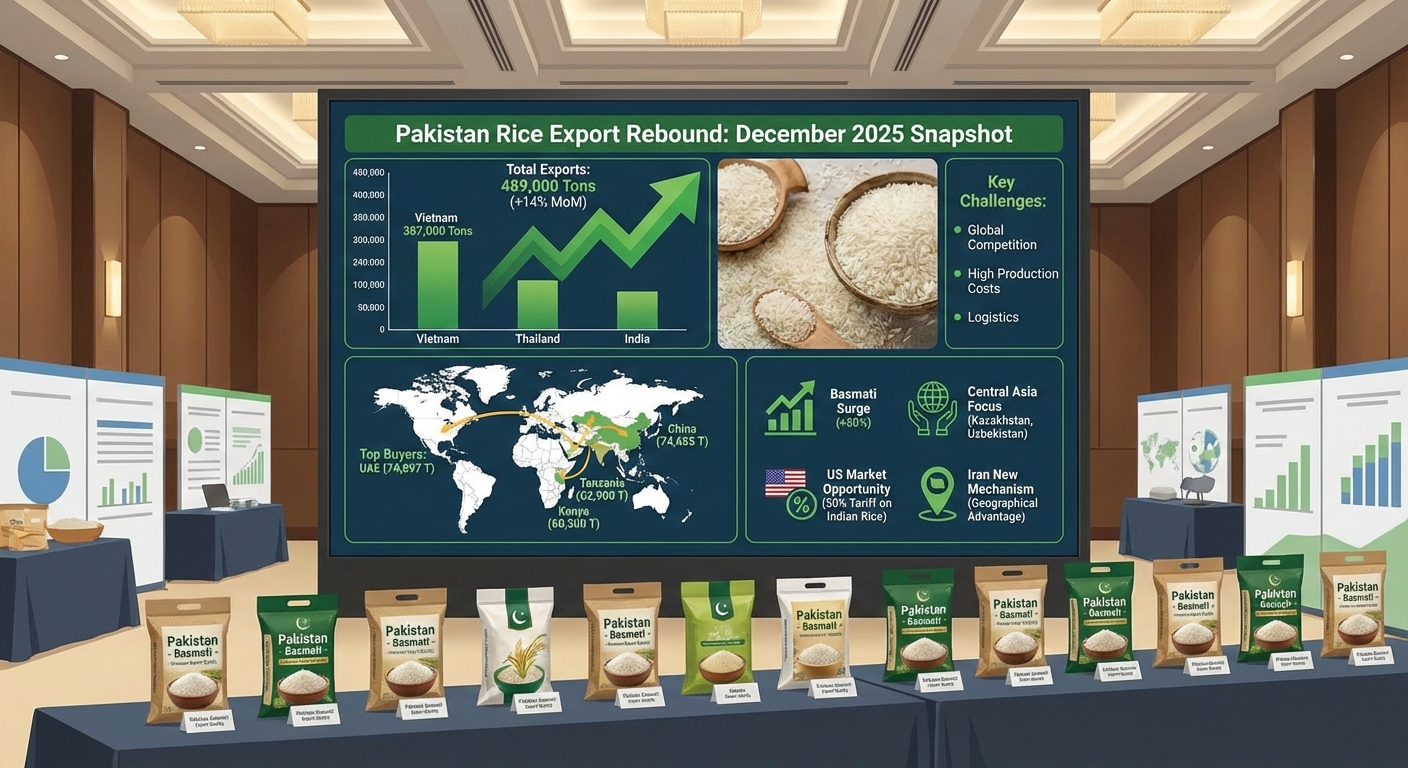
Pakistan’s rice export sector delivered its strongest monthly performance on record in December 2025. Total exports reached 489,000 metric tons — excluding shipments to Iran — surpassing Vietnam’s 387,000 tons and pushing Pakistan into third place among the world’s largest rice exporters for the month. Only India and Thailand exported more rice in December. A more than 50% surge in Basmati shipments drove the breakthrough, and new markets across Central Asia added structural depth to what has historically been a narrow export base. This article breaks down the numbers, maps the destinations, and examines what this milestone means for Pakistan’s rice sector going forward.
December by the Numbers: A 14% Month-on-Month Surge
Pakistan exported 489,000 metric tons of rice in December 2025 — a 14% increase over November’s already improved performance. Basmati shipments led the charge, rising by more than 50% month-on-month. That surge in premium rice exports is particularly significant because Basmati generates far higher revenue per ton than non-Basmati commodity varieties.
The result was historic. Pakistan overtook Vietnam — the world’s third-largest rice exporter — in a single month. Vietnam shipped 387,000 tons in December, leaving Pakistan ahead by more than 100,000 tons. Behind India and Thailand, Pakistan claimed third place globally for the month — a ranking that would have seemed improbable just a few months earlier when exports were running 40% below last year’s levels.
Where Pakistan’s Rice Is Going: A Market-by-Market Breakdown
December’s export data reveals a broad and geographically diverse buyer base — a healthy sign for an industry that has historically relied too heavily on a small number of markets.
The United Arab Emirates remained Pakistan’s single largest buyer, importing 74,897 tons — including 16,850 tons of Basmati. The UAE’s role as a regional distribution hub amplifies the real reach of those shipments across the Gulf and beyond.
China followed closely, receiving 74,685 tons. China’s re-entry as a significant buyer is noteworthy given its reduced purchasing earlier in the fiscal year as it drew down domestic stocks.
African markets delivered exceptional volume in December. Tanzania received 62,900 tons, Kenya imported 60,300 tons, Ivory Coast took 41,700 tons, Guinea-Bissau received 31,850 tons, and Madagascar imported 17,815 tons. Together, these five African destinations accounted for more than 234,000 tons — nearly half of December’s total export volume. Africa’s growing appetite for Pakistani rice represents one of the most important long-term growth opportunities in the sector.
Southeast Asia and the Gulf also contributed meaningfully. Malaysia imported 23,930 tons, while Saudi Arabia received 16,032 tons — including 5,350 tons of Basmati.
Europe and the United Kingdom combined for 21,100 tons, of which 15,600 tons was Basmati. That high Basmati share reflects the premium positioning of Pakistani aromatic rice among South Asian diaspora communities and discerning retail buyers in Western markets.
Smaller but strategically significant shipments reached Oman (5,770 tons), the United States (2,230 tons), and Canada (1,321 tons).
Central Asia: A Structural Shift in Pakistan’s Export Geography
Perhaps the most strategically significant development in December’s data is Pakistan’s growing presence in Central Asian markets. This is not a one-month anomaly — it reflects a deliberate and sustained pivot by Pakistani exporters toward a region that has historically been underserved.
Kazakhstan received more than 17,000 tons — including 10,300 tons of Basmati — making it one of Pakistan’s top ten export destinations for the month. Uzbekistan imported 10,382 tons. Beyond these two, Pakistani exporters are actively targeting Azerbaijan, Turkmenistan, Tajikistan, and Kyrgyzstan as part of a broader Central Asian strategy.
The driving force behind this shift is the closure of the Afghanistan border, which previously served as a transit route for Pakistani rice moving into Central Asia. Rather than accepting that lost channel as a permanent constraint, Pakistani exporters have developed direct trade routes to Central Asian buyers — bypassing Afghanistan entirely. Since the October 2025 harvest season, Central Asian demand has grown steadily, and the region is now emerging as a meaningful pillar of Pakistan’s export diversification strategy.
Central Asia’s appeal goes beyond volume. These markets have limited domestic rice production and rely heavily on imports. Furthermore, Pakistan enjoys a geographical advantage over distant competitors like Vietnam and Thailand. As exporters build direct relationships and logistics infrastructure in the region, Central Asia could become one of Pakistan’s most reliable export channels over the next several years.
New Opportunities: US Tariffs on India and Iran’s Market Shift
Two external developments are creating fresh opportunities for Pakistani rice exporters — and both deserve close attention.
US Tariffs on Indian Rice Open a Door
The United States has imposed a 50% tariff on Indian rice. That tariff makes Indian rice significantly more expensive for American buyers — and it is already producing results for Pakistan. Shipments to the United States reached 2,230 tons in December, and exporters report gradual but consistent growth in US-bound orders.
The US market is one of the world’s most valuable for premium rice — particularly Basmati. With Indian Basmati now facing a 50% price penalty at the US border, Pakistani Basmati becomes far more competitive. Exporters who invest in US market relationships, food safety certifications, and retail partnerships now have a genuine window to build lasting market share that was previously difficult to access.
Iran Shifts to Own-Fund Imports
Iran’s rice import market is undergoing a structural change that benefits Pakistani exporters. Previously, Iranian importers relied heavily on subsidized foreign currency provided by the government for rice purchases. That system has broken down as Iran’s economic crisis has deepened. Importers are now using their own funds to finance purchases.
Counterintuitively, this shift creates an advantage for Pakistan. Iranian importers using their own funds prioritize proximity, reliability, and relationship over government-directed sourcing. Pakistan’s geographical closeness to Iran — compared to India’s longer shipping routes — gives Pakistani exporters a logistical cost advantage. Reports suggest that approximately 300,000 tons of Basmati could flow from Pakistan to Iran under this new framework. If those shipments materialize, they would add substantially to Pakistan’s Basmati export volumes in the months ahead.
Where Pakistan Is Still Losing Ground
December’s strong performance should not obscure the markets where Pakistan remains underrepresented. Honest assessment of those gaps is essential for building a complete export strategy.
Iraq remains a glaring missed opportunity. Despite being one of the world’s largest rice importers and a near neighbor, Pakistan’s exports to Iraq are minimal. Regulatory challenges, competition from Indian and Thai exporters, and payment risk concerns have kept Pakistani rice largely out of the Iraqi market.
Turkey, Jordan, Syria, and parts of Eastern Europe also receive limited Pakistani rice shipments. These are markets with real demand and genuine potential — but Pakistani exporters have not yet built the trade relationships, logistics networks, or market knowledge needed to compete effectively in them.
Addressing these gaps requires targeted government support. Trade missions, bilateral agreements, export financing facilities, and market intelligence sharing can all help Pakistani exporters enter new territories where they currently have minimal presence.
The Structural Challenges That Remain
December’s record performance is genuinely encouraging. Nevertheless, industry analysts and exporters are clear that it does not resolve the underlying structural problems facing the sector.
Several interconnected barriers continue to limit Pakistan’s export potential.
High production costs remain the most fundamental challenge. The shift from the Final Tax Regime to the Normal Tax Regime added a significant tax burden to exporters’ cost structures. Combined with elevated energy costs for milling and high financing rates, Pakistani rice often carries a higher cost base than competing exporters — particularly India.
Rising freight and logistics costs are squeezing margins further. Global shipping rates have increased, and Pakistan’s port infrastructure and handling efficiency lag behind more developed export competitors.
Inconsistent financial policies undermine long-term planning. Exporters cannot commit to multi-year supply relationships with overseas buyers when domestic policy — on taxation, subsidies, and currency management — shifts unpredictably.
Hoarding and border security closures disrupt supply chains internally, reducing the volume of paddy reaching mills and limiting the stock available for export.
Weak international demand in several traditional markets — including reduced buying from China and the Philippines — continues to cap the ceiling on overall export volumes.
The government has instructed the preparation of a comprehensive strategy to strengthen rice exports and reduce the trade deficit. That mandate is welcome. However, translating it into concrete, time-bound policy actions — rather than another committee report — is what the industry actually needs.
Bangladesh: Strong Demand Despite High Freight Costs
Bangladesh deserves a separate mention as one of Pakistan’s most important emerging bilateral markets. Despite high freight costs that erode margins on Bangladesh-bound shipments, demand from Dhaka remains strong. The G2G framework — under which Pakistan has now secured approximately 200,000 metric tons of orders from Bangladesh within a single year — continues to deliver reliable volume.
Bangladesh is still working toward its annual rice import target of close to 900,000 metric tons, driven by flood-related production losses. As long as that import need persists, Pakistan has a strong case to pursue additional G2G agreements with Dhaka beyond the current committed volumes.
Outlook: Sustaining the Momentum Into 2026
December’s record performance demonstrates that Pakistan’s rice export sector has genuine capacity and real competitive strength — particularly in Basmati and in African and Central Asian markets. The task now is to sustain and build on that momentum through the remainder of FY2026.
Several tailwinds are working in Pakistan’s favor heading into 2026. US tariffs on Indian rice are redirecting premium buyers toward Pakistani alternatives. Iran’s shift to own-fund importing favors geographically proximate suppliers. Central Asian markets are growing steadily. And Bangladesh’s import program continues to provide reliable G2G volume.
To convert a strong December into a strong fiscal year, however, Pakistan must address its structural cost disadvantages, push for policy consistency, and invest seriously in the markets — Iraq, Turkey, Eastern Europe, the US — where it currently punches well below its weight.
The third-place global ranking Pakistan achieved in December 2025 is not just a statistical milestone. It is proof that the country’s rice sector can compete at the highest level when conditions align. The goal now is to create those conditions consistently — through policy reform, market diversification, and sustained commercial execution.

The Agri-Crop editorial team comprises commodity market analysts, rice trade specialists, and agriculture industry professionals based in Pakistan. We track daily price movements, export data, and policy developments across Pakistan’s key agricultural sectors.