
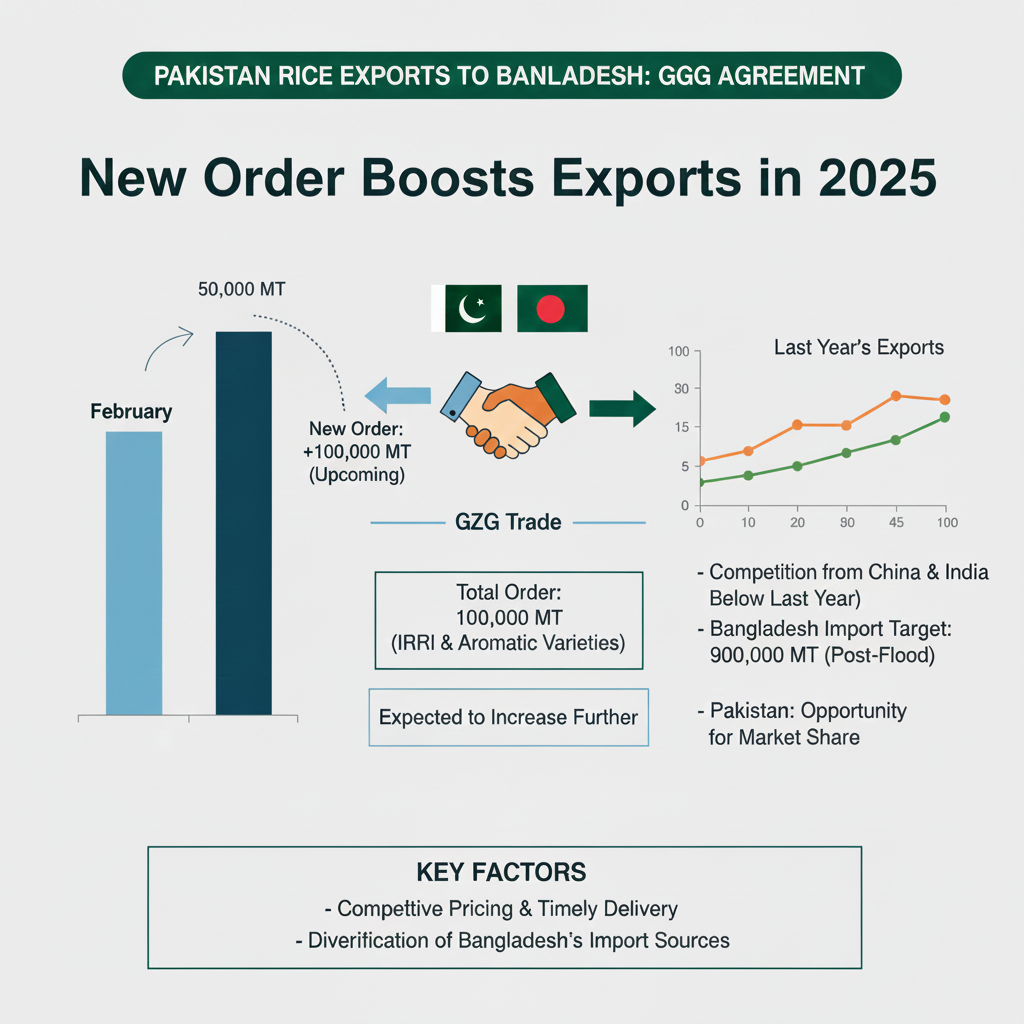
Pakistan is securing a significant rice export order through a government-to-government (G2G) trade agreement with Bangladesh. The new tender covers 100,000 metric tons of rice and will ship in multiple consignments over the coming months. This deal builds on an already active trade relationship between the two countries and opens the door to further export growth — if Pakistan prices its rice competitively.
The New Order: What It Covers
The 100,000-ton tender includes both IRRI varieties and aromatic rice. Pakistan will ship the rice in multiple consignments, spreading deliveries across several months.
This is not Pakistan’s first G2G rice deal with Bangladesh. The two countries launched this trade channel in February this year, when Pakistan supplied 50,000 metric tons to Bangladesh under a similar arrangement. The new order doubles that initial volume. It signals that Bangladesh views Pakistan as a reliable supplier and wants to deepen the relationship.
Pakistan has already exported 61,000 metric tons of rice to Bangladesh in October alone. Adding this new 100,000-ton order pushes the total volume significantly higher and gives Pakistan’s rice exporters a much-needed boost during a difficult export season.
Why Bangladesh Needs to Import So Much Rice
Bangladesh is not importing out of preference. It is importing out of necessity.
The country suffered consecutive floods during the last fiscal year. Those floods wiped out more than 1 million metric tons of domestic rice production. That is a devastating loss for a country that depends heavily on rice as its primary staple food.
To fill the gap and stabilize local prices, the Bangladesh government set an import target of close to 900,000 metric tons of rice for this year. That is a large volume — and Bangladesh is actively sourcing from multiple countries to meet it.
This is where the opportunity lies for Pakistan.
Bangladesh Is Diversifying Its Import Sources
Bangladesh is not relying on a single supplier. It is deliberately spreading its import orders across multiple countries. The goal is to ensure consistent supply and reduce dependence on any one market.
India has historically been Bangladesh’s dominant rice supplier. But Bangladesh’s push to diversify creates real space for other exporters — including Pakistan — to step in and build long-term supply relationships.
Pakistan’s participation in this diversification strategy is strategically important. Each successful delivery builds trust. Each competitive price offer strengthens Pakistan’s position for future tenders. Bangladesh imports substantial volumes every year, and a reliable position in that supply chain has long-term value beyond any single order.
The Pricing Challenge: Pakistan Must Bid Aggressively
Winning this order is one thing. Winning future orders requires a disciplined pricing strategy.
Bangladesh runs a competitive tender process. Multiple countries bid for each contract. Pakistan faces stiff competition — particularly from India and China, both of which have ample rice stocks and the ability to offer low prices.
Pakistan must offer rice at the lowest viable price point. Bidding too high risks losing the contract to a cheaper competitor. Losing contracts now means losing future opportunities as Bangladesh builds its preferred supplier list.
This creates a real tension for Pakistani exporters. Domestic rice prices have risen in recent weeks — partly due to strong feed miller demand pulling broken rice off the market. IRRI rice prices have also started rising following the announcement of this new tender, as suppliers rush to secure inventory and position themselves for export orders.
Rising domestic prices make it harder to offer competitive export prices without sacrificing margins. Pakistan must balance the need to win contracts against the need to export profitably.
Competition From India and China Is Intense
Despite this large G2G order, Pakistan’s overall rice exports remain below last year’s levels. The reason is clear — India and China are both supplying ample rice to global markets at competitive prices.
India holds large carryover stocks and expects a strong harvest of 150 million metric tons this season. Indian exporters are offering aggressively to clear those stocks. China’s elevated rice inventories are also adding to global supply pressure.
In this environment, Pakistan cannot afford to be complacent. The Bangladesh G2G deal provides a meaningful volume boost — but it does not solve the broader competitiveness challenge. Pakistan needs a sustained strategy to remain price-competitive across all its key export markets.
What This Deal Means for Pakistan’s Rice Sector
The 100,000-ton Bangladesh order carries significance beyond the immediate revenue it generates.
It supports export volumes during a weak season. Pakistan’s broken rice and IRRI exports are running well below last year’s pace. This G2G deal injects meaningful volume into an otherwise slow export calendar.
It strengthens a bilateral trade channel. G2G agreements provide stability that open-market spot trading does not. Once established, these agreements tend to repeat and grow. Pakistan’s February deal led to this larger October tender. The next order could be larger still — if Pakistan delivers on time and at the agreed price.
It positions Pakistan in Bangladesh’s supply chain. As Bangladesh works toward importing 900,000 metric tons this year, it needs multiple reliable suppliers. Pakistan earning a consistent spot in that rotation has long-term value for the country’s rice export industry.
It signals demand for aromatic varieties. The inclusion of aromatic rice in this tender is notable. It suggests Bangladesh sees Pakistan as a source for premium varieties — not just commodity rice. That opens additional revenue potential beyond the IRRI bulk trade.
What Pakistan Must Do to Capitalize
This opportunity will not deliver itself. Pakistan needs to execute on several fronts.
Price competitively. Future tenders depend on winning this one cleanly. Pakistan must offer rates that beat or match competing bids without locking in unprofitable margins.
Deliver on time. Bangladesh is importing to stabilize domestic food prices after devastating floods. Delays hurt the buyer and damage Pakistan’s reputation as a reliable supplier. Timely shipment across all consignments is non-negotiable.
Scale up milling capacity. Many rice mills in Pakistan are currently operating below capacity due to weak domestic export demand. The industry needs to prepare for increased throughput as G2G and other export orders build up over the coming months.
Pursue additional G2G opportunities. Bangladesh is one market. Other countries facing supply shortfalls — particularly in Africa and the Middle East — are also looking for reliable rice suppliers. Pakistan’s government should actively pursue similar G2G frameworks in those markets.
Outlook: A Strategic Moment for Pakistan’s Rice Exports
The Bangladesh deal arrives at a critical moment for Pakistan’s rice export sector. The current fiscal year has started slowly. Competition is intense. Margins are tight.
But this 100,000-ton order demonstrates that Pakistan has a real role to play in meeting global rice demand — particularly when natural disasters create sudden import needs in key markets.
The next few months will test Pakistan’s ability to deliver on this order while pursuing additional export contracts. Countries that build reliable supply relationships during times of need tend to hold those relationships long after the crisis passes. Bangladesh’s import need is urgent. Pakistan’s window to establish itself as a preferred supplier is open right now.

The Agri-Crop editorial team comprises commodity market analysts, rice trade specialists, and agriculture industry professionals based in Pakistan. We track daily price movements, export data, and policy developments across Pakistan’s key agricultural sectors.