
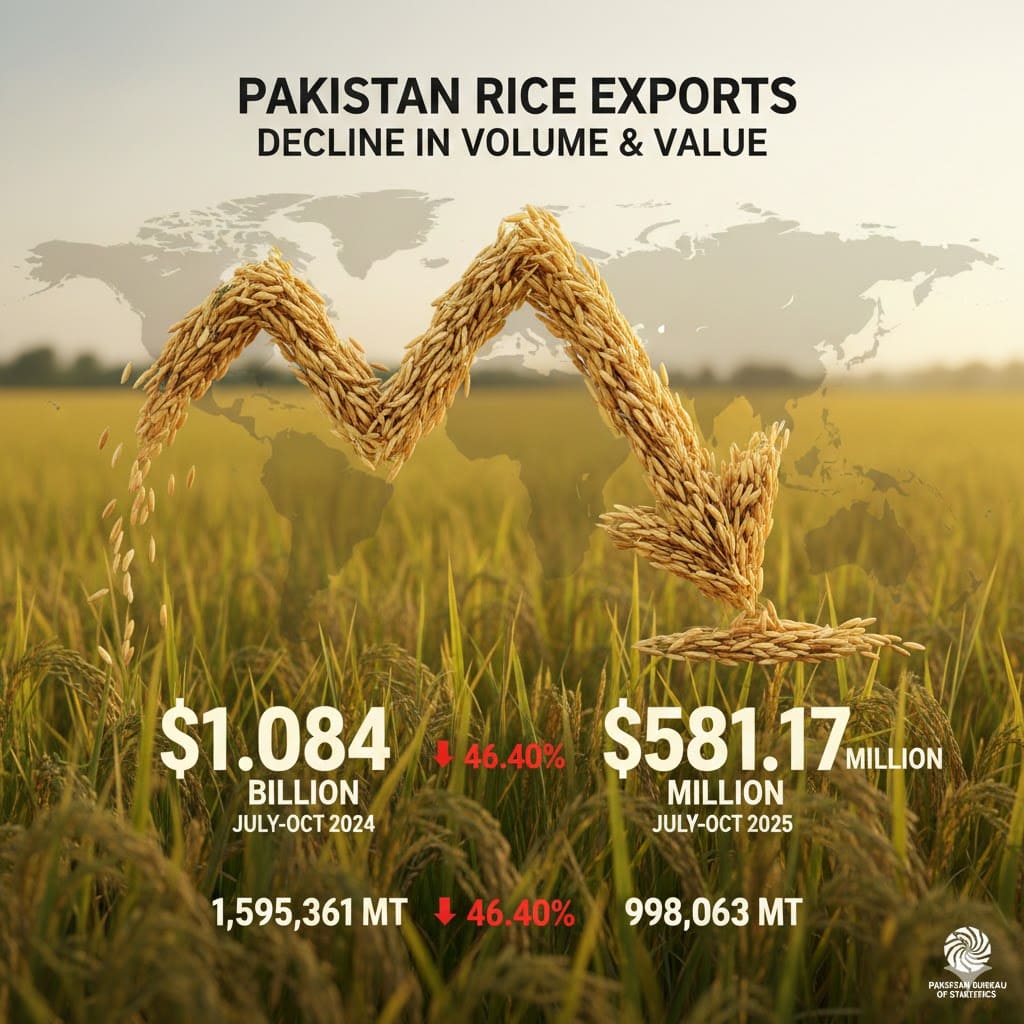
Pakistan’s rice export sector is facing its most difficult year in recent memory. In just four months, the country has lost nearly half its export volume and revenue compared to last year. India’s return to the export market, lower international prices, and a widening price gap with regional competitors are all squeezing Pakistan out of key markets. This article breaks down the numbers, examines the causes, and explains what is at stake for Pakistan’s economy.
The Numbers: A 46% Decline in Four Months
The data from the Pakistan Bureau of Statistics tells a stark story.
During the first four months of fiscal year 2025–26 — July through October — Pakistan exported 998,063 metric tons of rice. In the same period last year, it exported 1,595,361 metric tons. That is a decline of nearly 600,000 metric tons in just four months.
The revenue drop is equally severe. Pakistan earned $581.17 million from rice exports during this period. Last year, the same four months generated $1.084 billion. That is a 46.40% decline in both volume and value — almost half of last year’s earnings gone in a single season.
Basmati vs. Non-Basmati: Both Categories Are Down
The export decline cuts across both of Pakistan’s major rice categories.
Basmati rice exports reached 182,807 metric tons, generating $202.36 million. Last year, Pakistan earned $331.82 million from Basmati exports during the same period. That is a revenue drop of roughly $130 million from premium aromatic varieties alone.
Non-Basmati rice exports hit 815,256 metric tons, valued at $378.82 million. Last year, Pakistan shipped 1.277 million metric tons of non-Basmati rice worth $752.38 million. Volume fell by over 460,000 metric tons and revenue dropped by more than $370 million.
Non-Basmati rice — particularly IRRI-6 and broken rice varieties — drives the bulk of Pakistan’s export volumes. The steep decline in this category is the primary reason overall exports have collapsed so sharply.
One Bright Spot: The Bangladesh Order
Some relief is coming through a new G2G export order from Bangladesh.
Pakistan is set to export 100,000 metric tons of rice to Bangladesh under a government-to-government agreement. Eleven companies competed in the tender. Jhulay Lal Company submitted the winning bid — the lowest price in the competition at $394.98 per ton (CIF liner out). Other bids ranged from $397.25 to $424.80 per ton.
Winning at the lowest price shows Pakistan can compete when it prices aggressively. But it also highlights the margin pressure exporters face. The gap between winning bids and higher offers was narrow — just a few dollars per ton separates winners from losers in these tenders.
This Bangladesh order will add meaningful volume to Pakistan’s export tally. But it is not large enough to reverse the overall decline. Exports will likely remain well below last year’s levels for the remainder of the fiscal year unless broader market conditions improve.
Why Pakistan Is Losing Market Share
Several forces are working against Pakistan’s rice exporters at the same time.
India Returned to the Export Market
This is the single biggest factor. India previously restricted its rice exports to protect domestic food supplies. When it lifted those restrictions, a flood of competitively priced Indian rice entered global markets.
India is a massive producer. It expects to harvest 150 million metric tons of rice this season and holds large carryover stocks. Indian exporters are offering aggressively to clear those stocks. That has pushed international rice prices lower across the board — and Pakistan has struggled to match those prices while maintaining profitability.
Pakistan’s Prices Are Higher Than Competitors
The price gap between Pakistan and its competitors is now a serious problem across both rice categories.
In premium Basmati, Pakistan sells Super Basmati at around $1,200 per ton. India offers comparable grades at $900 per ton. That is a $300 per ton gap — or 25% cheaper. Many buyers who previously chose Pakistani Basmati are now switching to Indian alternatives at that price difference.
In non-Basmati 5% broken rice, Vietnam and Thailand are selling at $350 per ton. Pakistan and India are both at $370 per ton — roughly 6% more expensive. That gap is enough to push price-sensitive buyers toward Southeast Asian suppliers.
When competitors offer similar quality at lower prices, buyers make rational decisions. Pakistan is losing orders it would have won comfortably last year.
International Prices Have Fallen
Lower global rice prices hurt Pakistan more than most competitors. India and Thailand have lower production costs and can absorb price declines more easily. Pakistan’s domestic costs — paddy prices, milling costs, logistics — remain relatively high. When international prices fall, Pakistan’s margins compress faster than those of lower-cost competitors.
The Economic Stakes: Current Account Deficit at Risk
Rice is not just an agricultural commodity for Pakistan. It is a critical source of foreign exchange earnings.
Experts are warning that the ongoing export decline could worsen Pakistan’s current account deficit, which analysts forecast to reach around $3 billion in FY2026. A weaker rice export performance means less dollar inflow — making it harder for Pakistan to manage its external account and currency pressures.
Pakistan ranks as the fourth-largest rice exporter globally. That position took years to build. Losing market share now — to India in Basmati and to Vietnam and Thailand in non-Basmati — risks damaging long-term trade relationships that are difficult to rebuild once lost.
What Pakistan Needs to Do
Reversing this trend requires action on multiple fronts.
Reduce domestic rice prices. The root cause of lost competitiveness is the gap between domestic costs and international price levels. Paddy prices in Pakistan need to align more closely with global benchmarks. Until that happens, exporters cannot offer competitive rates without absorbing losses.
Pursue more G2G agreements. The Bangladesh deal shows that government-to-government trade can unlock large, reliable volumes. Pakistan’s government should actively pursue similar agreements with other rice-importing nations — particularly in Africa, the Middle East, and Southeast Asia.
Protect Basmati’s premium positioning. The $300 per ton gap with Indian Basmati is unsustainable if it persists. Pakistan should invest in quality certification, geographical indication protection, and international marketing to justify its Basmati premium. Competing purely on price against India in the Basmati segment is a losing strategy.
Support millers and exporters through the slow season. Many rice mills are operating below capacity right now. Export credit facilities, reduced financing costs, and government-backed trade guarantees can help exporters stay active in the market during difficult periods rather than pulling back entirely.
Outlook: A Tough Road Through FY2026
Pakistan’s rice export sector will not recover quickly. India is back in the market with large stocks and aggressive pricing. International prices remain soft. Domestic costs are stubbornly high.
The Bangladesh G2G order provides a floor — but not a ceiling. Pakistan needs more deals like it, more competitive pricing, and a broader strategy to defend its position as the world’s fourth-largest rice exporter.
The next six months will be defining. If Pakistan can close more G2G agreements, align domestic prices closer to global benchmarks, and defend its Basmati premium through quality differentiation, it can limit the damage and position itself for a stronger FY2027.
If it cannot, the current account consequences will be felt well beyond the rice sector.

The Agri-Crop editorial team comprises commodity market analysts, rice trade specialists, and agriculture industry professionals based in Pakistan. We track daily price movements, export data, and policy developments across Pakistan’s key agricultural sectors.