
Pakistan’s rice export sector is navigating one of its most turbulent fiscal years on record. A 40.5% revenue decline over the first seven months tells one part of the story. However, a 14.73% year-on-year increase in January 2026 tells another — one that suggests the worst may be passing. This article unpacks both trends, examines the government’s response, and outlines where Pakistan’s exporters are focusing their energy to rebuild momentum.
Seven Months of Decline: The Full Picture
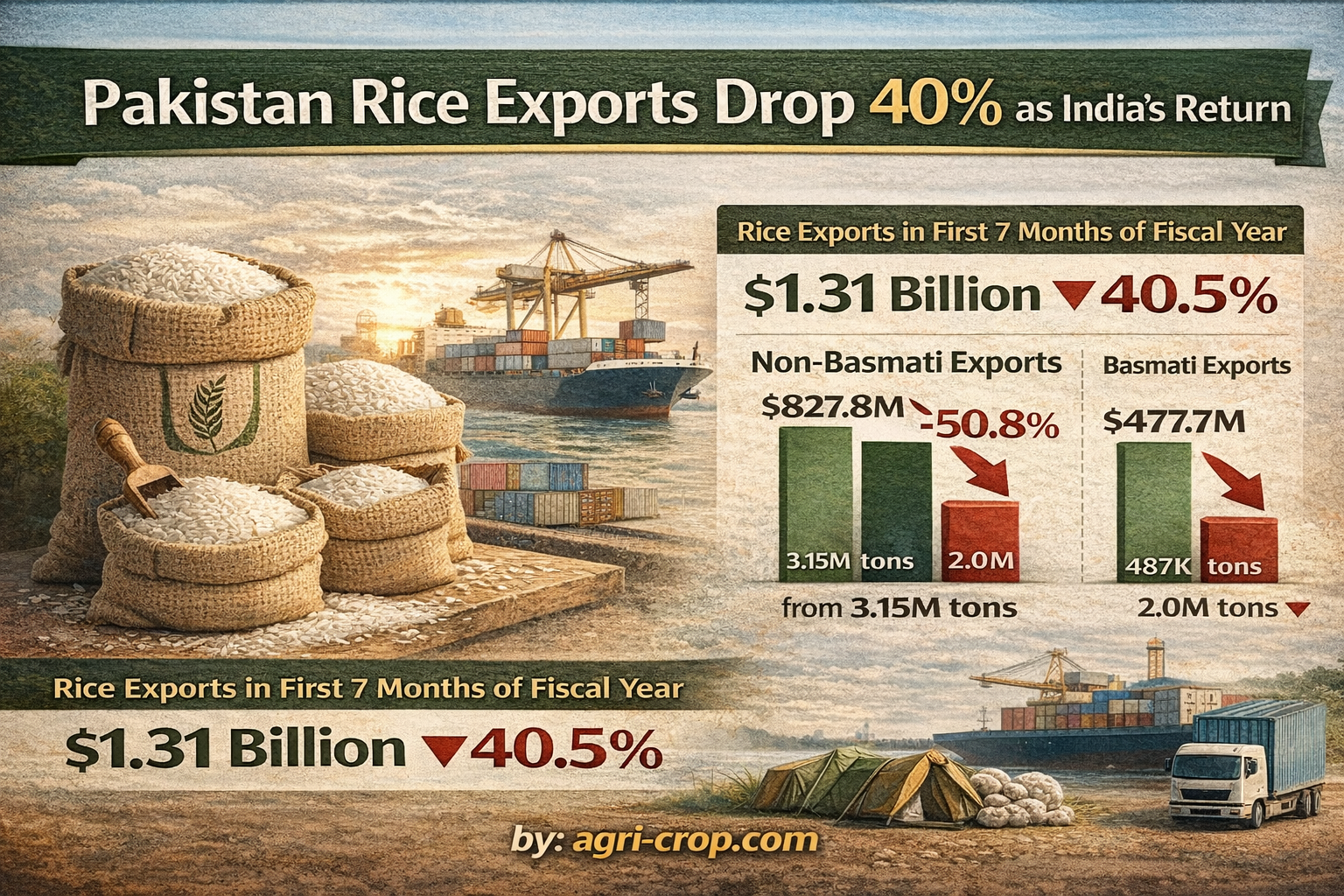
Pakistan earned $1.31 billion from rice exports during July through January of FY2025–26. The 40.5% revenue decline reflects both lower volumes and weaker international prices — a double blow that has compressed earnings across the entire sector.
The table below summarizes the damage across both major rice categories:
| Category | Revenue FY2025-26 | Revenue FY2024-25 | Change | Volume FY2025-26 | Volume FY2024-25 |
|---|---|---|---|---|---|
| Non-Basmati | $827.8 million | ~$1.68 billion | -50.8% | 2.0 million tons | 3.15 million tons |
| Basmati | $477.7 million | ~$511.6 million | -6.62% | 436,484 tons | 487,278 tons |
| Total | $1.31 billion | ~$2.19 billion | -40.5% | — | — |
Non-Basmati rice suffered the steeper fall — a loss of more than 1.1 million metric tons of export volume in a single fiscal year. That staggering reduction reflects how aggressively India recaptured commodity rice markets after lifting its export restrictions.
Basmati rice held up comparatively better. The smaller percentage decline reflects its premium positioning. Buyers who specifically seek Pakistani Super Basmati for its distinctive aroma and quality are less easily swayed by Indian price competition than commodity rice buyers.
January 2026: A Genuine Turnaround Signal
Against the difficult seven-month backdrop, January 2026 delivered a genuinely encouraging result. Pakistan earned $366 million from rice exports during the month — up from $319 million in January 2025. That $47 million increase translates to a 14.73% year-on-year growth rate.
This is the first month in which Pakistan outperformed the same month of the previous year in revenue terms. Consequently, it carries real significance. It suggests that the structural low point may be behind the sector, and that improving market conditions — combined with the government’s new policy interventions — are beginning to produce results.
Moreover, this January figure builds on December 2025’s record-breaking performance, when Pakistan temporarily became the world’s third-largest rice exporter. Two consecutive strong months indicate momentum rather than a one-off anomaly. Nevertheless, sustained recovery requires more than two good months — the structural challenges that drove the seven-month decline have not disappeared.
Why Pakistan Lost So Much Ground: India’s Return
The Ministry of National Food Security and Research explained the situation clearly to a parliamentary committee. India’s increased rice supplies made Pakistani rice less competitive in international markets. That straightforward assessment captures the core of the problem.
India re-entered the global rice market with large surplus stocks and aggressive pricing. Pakistani non-Basmati varieties — particularly IRRI-6 and IRRI-9 — lost buyers across Africa, the Middle East, and Asia to cheaper Indian alternatives almost immediately.
Furthermore, India’s structural advantages amplify the competitive pressure it exerts:
- Free trade agreements with several of Pakistan’s key export markets reduce or eliminate import tariffs on Indian rice, while Pakistani rice faces full duties.
- Substantial domestic subsidies cover inputs, power, and procurement guarantees — allowing Indian exporters to offer lower prices without sacrificing profitability.
- Large surplus stocks from bumper harvests give Indian exporters the volume and pricing flexibility to undercut competitors across multiple markets simultaneously.
Together, these advantages give India a formidable edge in commodity rice markets. Until Pakistan addresses its own cost structure and secures comparable market access, competing with India in price-sensitive segments will remain extremely difficult.
The Government Responds: A 9% Basmati Export Rebate
Recognizing the severity of the competitive challenge, the Ministry of Commerce acted in January 2026. On January 23, the government issued a notification under the “Drawback of Local Taxes and Levies on Rice Order, 2026.”
The measure grants a 9% rebate on the FOB value of Basmati rice exports priced above $750 per metric ton. It works by returning a portion of the taxes and levies embedded in the export cost structure — directly improving exporters’ net margins and allowing them to quote more competitive prices to international buyers.
The $750 per ton price floor is deliberate. It prevents the rebate from subsidizing low-value Basmati exports and focuses government support on premium shipments that generate the highest foreign exchange earnings per ton.
Industry participants have welcomed the rebate as a positive first step. However, many argue that a 9% drawback does not fully offset the cost disadvantage created by the FTR-to-NTR tax regime shift and rising production costs. Additional measures targeting non-Basmati exports and broader cost reduction will likely be necessary to achieve a full sector recovery.
Market Diversification: Where Exporters Are Focusing
In parallel with government policy action, Pakistan’s rice exporters are pursuing their own strategic response — diversifying toward buyers who offer better pricing or stronger demand fundamentals.
The chairman of the Pakistan Rice Exporters Association outlined the current market structure:
- Basmati flows primarily to the Middle East and European Union — markets where quality and aroma matter more than absolute price, and where Pakistani Super Basmati commands a meaningful premium over Indian alternatives.
- Non-Basmati ships to the Philippines, Indonesia, Malaysia, and African countries — high-volume commodity markets where price competition is fierce and India’s cost advantage is most pronounced.
To counter the slowdown, exporters are actively targeting four priority markets for volume expansion:
- China — took 74,685 tons in December 2025 alone, but overall volumes remain below potential. As China draws down domestic stocks and resumes regular import buying, Pakistan needs established relationships and competitive pricing ready to capture those orders.
- The Philippines — currently under an import ban to protect domestic farmers, but that ban will eventually lift. Pakistani exporters who maintain relationships during the ban period will be better positioned to capture orders when buying resumes.
- Indonesia — a large Asian importer with substantial rice import needs. The government’s rebate measure should help Pakistani exporters compete more effectively for Indonesian tenders.
- Bangladesh — continues to deliver reliable volume through the G2G channel despite high freight costs. Pakistan should pursue additional G2G agreements with Dhaka beyond current committed volumes.
Central Asia and the US: Two Emerging Opportunities
Beyond the four priority markets, two additional export channels are showing real promise.
Central Asia has emerged as a genuine growth market since the October 2025 harvest season. Pakistani exporters have developed direct trade routes to the region after the Afghanistan border closure, and demand is growing steadily across:
- Kazakhstan
- Uzbekistan
- Azerbaijan
- Turkmenistan
- Tajikistan
- Kyrgyzstan
These markets have limited domestic rice production, appreciate Pakistani Basmati quality, and offer less direct Indian competition than more established export destinations.
The United States is opening up because of Washington’s 50% tariff on Indian rice. That tariff makes Indian Basmati significantly more expensive for American buyers — creating a direct opening for Pakistani exporters. Shipments to the US are growing gradually, and exporters who invest now in US food safety certifications, retail partnerships, and brand building can capture durable market share in one of the world’s most valuable premium rice markets.
Outlook: Recovery Is Underway, But Work Remains
January 2026’s year-on-year growth, combined with December 2025’s record volumes, suggests that Pakistan’s rice export sector has turned a corner. Nevertheless, the underlying structural issues have not been resolved.
Tailwinds supporting continued recovery:
- The 9% Basmati rebate improves export economics immediately
- US tariffs on Indian rice are redirecting premium buyers toward Pakistan
- Central Asian demand is growing steadily across six markets
- The Bangladesh G2G channel remains active and reliable
- Iran’s shift to own-fund importing creates a geographical advantage for Pakistani suppliers
Headwinds that still require attention:
- High production costs and the NTR tax burden have not been addressed fully
- India’s FTA advantages in key markets remain intact
- Inconsistent domestic policy continues to undermine long-term export planning
- Non-Basmati competitiveness against India remains structurally weak without further cost relief
The sector has shown it can perform at a world-class level when conditions align. The task now is to create those conditions consistently — through policy reform, market investment, and sustained commercial execution across a diversified export base.

The Agri-Crop editorial team comprises commodity market analysts, rice trade specialists, and agriculture industry professionals based in Pakistan. We track daily price movements, export data, and policy developments across Pakistan’s key agricultural sectors.