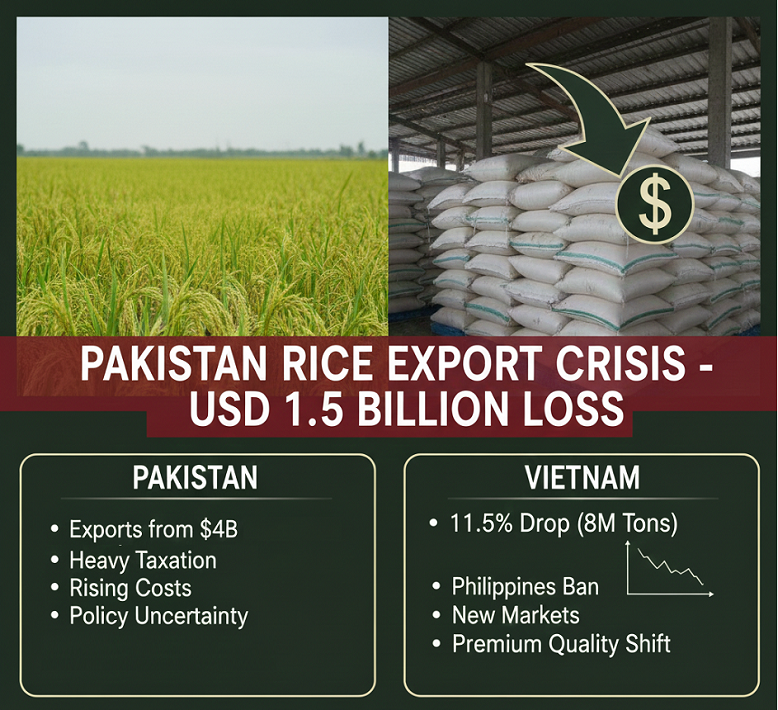
Pakistan’s rice export industry is in serious trouble. Exporters who once rode a historic surge — from USD 300 million to USD 4 billion in annual earnings — are now reporting losses. Heavy taxation, rising costs, and unpredictable government policies are pushing the sector to a breaking point. Meanwhile, economists are calling the USD 1.5 billion drop in rice export earnings one of the most serious economic blows Pakistan has faced in recent years. This article examines what is driving the crisis, how Vietnam is navigating a similar challenge, and what Pakistan must do to protect its rice export future.
From USD 4 Billion to Mounting Losses: How Did Pakistan Get Here?
Pakistan’s rice export journey is remarkable — and the current reversal makes it all the more painful.
Over the past decade, the sector transformed from a modest contributor into one of Pakistan’s most valuable export industries. Annual rice export earnings climbed from around USD 300 million to nearly USD 4 billion at their peak. That growth reflected real investment, expanding trade relationships, and strong global demand for Pakistani rice — particularly Basmati and IRRI varieties.
Today, however, many of those same exporters are reporting losses. The industry that built itself into a USD 4 billion powerhouse is now shrinking. Economists estimate that Pakistan has lost USD 1.5 billion in rice export earnings — a decline severe enough to affect the country’s broader external account and foreign exchange position.
Three Forces Driving the Crisis
Rice exporters and industry analysts point to three overlapping problems that are strangling the sector simultaneously.
1. Heavy Taxation Is Destroying Margins
Taxation on rice exports in Pakistan has grown to levels that exporters describe as unsustainable. Multiple taxes apply at different stages of the supply chain — from paddy procurement through milling to final export. Each layer reduces the margin available to exporters competing in price-sensitive international markets.
When competitors like India, Vietnam, and Thailand operate with lower tax burdens, Pakistani exporters face a structural disadvantage. They must either absorb the tax cost — which eliminates profit — or pass it on through higher prices, which makes Pakistani rice less competitive against cheaper alternatives.
2. Rising Costs Are Squeezing Exporters Further
Beyond taxation, the overall cost of doing business in Pakistan’s rice sector has risen sharply. Energy costs for milling operations have increased significantly. Financing costs remain high in a tight monetary environment. Logistics and port handling charges add further pressure.
Each of these cost increases compounds the tax burden. Together, they push the breakeven export price higher — at exactly the moment when international rice prices are falling due to oversupply from India and other major exporters.
3. Uncertain Government Policies Are Undermining Confidence
Perhaps the most damaging factor is policy uncertainty. Exporters cannot plan effectively when government decisions — on export taxes, subsidies, wheat bans, or currency management — shift without warning.
Investment in milling capacity, storage, and trade relationships requires a stable policy environment. When exporters cannot predict what the rules will be next quarter, they pull back. Mills sit idle. Orders go unfulfilled. Buyers turn to more reliable suppliers. The business community across Pakistan’s rice sector is calling for clearer, more consistent policy — and warning that without it, the industry’s decline will accelerate.
Vietnam Faces a Similar Challenge — And Is Responding Strategically
Pakistan is not alone in facing rice export headwinds. Vietnam — the world’s third-largest rice exporter — is navigating its own significant slowdown this year.
Vietnam expects its rice exports to fall by 11.5% in 2025, sliding to around 8 million tons. A major driver of that decline is the Philippines, one of Vietnam’s largest buyers.
Manila enforced an import ban on Vietnamese rice to protect its domestic farmers. The ban, which remains in place until year-end, has sharply curtailed one of Vietnam’s most important export channels. Traders believe the Philippines may extend the ban beyond December, creating further uncertainty for Vietnamese exporters.
Despite this setback, Vietnam is not waiting for conditions to improve on their own. Instead, it is actively pursuing two strategies simultaneously.
First, it is targeting new markets. Vietnamese exporters are identifying alternative buyers to replace lost Philippine demand. They are approaching markets in Africa, the Middle East, and other parts of Asia — diversifying their customer base to reduce dependence on any single country.
Second, it is shifting toward premium-quality rice. Rather than competing purely on volume and price, Vietnam is repositioning itself in the higher-value segment of the global rice market. Experts backing this strategy argue that there is no major competition for high-end rice — and that Vietnam can comfortably maintain exports of 8–9 million tons annually by capturing premium demand that lower-cost competitors cannot serve.
That combination of market diversification and quality upgrading is a textbook response to a competitive squeeze. It is also precisely the kind of strategic thinking Pakistan needs to apply to its own situation.
What Pakistan Must Learn From Vietnam
Vietnam’s response to its export slowdown offers a direct blueprint for Pakistan. The parallels between the two countries’ challenges are clear — and so are the solutions.
Pakistan must pursue premium positioning for Basmati. Pakistan’s Super Basmati is a genuinely differentiated product. No other country produces an exact equivalent. Yet Pakistan is currently underinvesting in the international marketing, quality certification, and geographical indication protection needed to command a true premium. Vietnam’s experts are right that high-end rice faces no major competition. Pakistan needs to own that space more aggressively.
Pakistan must diversify its export markets. An over-reliance on a small number of buyers creates vulnerability. The Bangladesh G2G agreement is a positive step — but it is one deal. Pakistan needs systematic efforts to open new markets across Africa, the Middle East, Central Asia, and Southeast Asia, reducing dependence on any single buyer or region.
Pakistan must stabilize its policy environment. Vietnam’s exporters operate within a clearer, more predictable framework. Pakistan’s exporters need the same. Consistent taxation policy, reliable export financing, and transparent procurement rules would restore confidence and encourage investment in the sector.
The Farmer Dimension: Crop Switching Is a Real Risk
The crisis in rice exports is not just a problem for millers and traders. It reaches all the way back to the farm.
When export demand falls and prices weaken, farmers feel it directly through lower paddy prices at the mill gate. If those prices fall below the cost of production — or simply below what competing crops can offer — farmers make rational decisions. They switch to wheat, cotton, sugarcane, or other alternatives that promise better returns.
If Pakistani farmers shift away from rice in significant numbers next planting season, the consequences will compound. Lower rice cultivation means less paddy supply, which means less milled rice available for export, which means Pakistan loses market share it may never recover. Once buyers establish supply relationships with alternative exporters, they rarely return without a compelling reason.
Securing high-quality rice export orders now — before the next planting cycle — is therefore urgent. Every order Pakistan wins at a viable price sends a signal to farmers that rice remains worth growing. Every order Pakistan loses sends the opposite message.
The Economic Stakes Could Not Be Higher
The USD 1.5 billion decline in rice export earnings is not an abstract statistic. It represents real pressure on Pakistan’s foreign exchange reserves, real stress on its current account, and real losses for hundreds of thousands of farmers, millers, traders, and exporters across the supply chain.
Pakistan’s current account deficit is already forecast to reach around USD 3 billion in FY2026. A weakened rice export sector makes that target harder to manage. Conversely, a recovered rice export sector — generating USD 3.5 to 4 billion annually — would provide meaningful relief to Pakistan’s external account and support macroeconomic stability.
The rice sector’s problems are solvable. Vietnam is demonstrating that even in a difficult global environment, a strategic response — premium positioning, market diversification, and policy clarity — can protect export volumes and revenues.
Pakistan has the crop, the history, and the trade relationships to mount a similar recovery. What it needs now is the policy will and industry coordination to make it happen.

The Agri-Crop editorial team comprises commodity market analysts, rice trade specialists, and agriculture industry professionals based in Pakistan. We track daily price movements, export data, and policy developments across Pakistan’s key agricultural sectors.