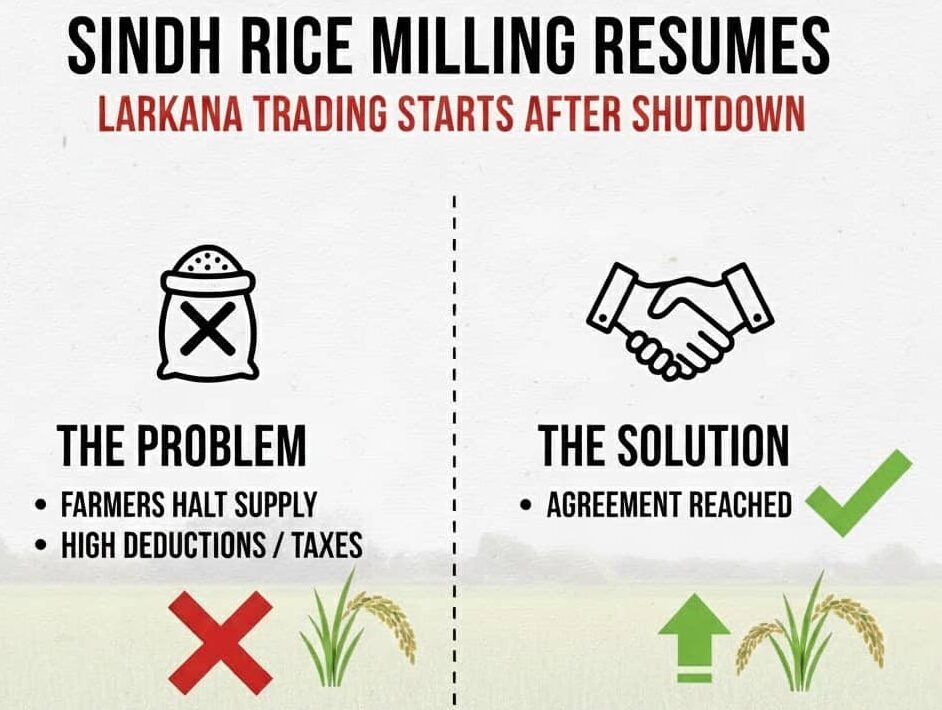
Rice milling in Sindh ground to a halt for nearly a week. Farmers stopped supplying paddy to mills, traders sat idle, and the entire supply chain froze. The trigger was a longstanding grievance — unfair deductions and hidden taxes eating into farmer incomes at the mill gate. This week, stakeholders reached a landmark agreement that resolved the dispute and reopened the market. Here is what happened, what changed, and what it means for Sindh’s rice sector going forward.
Why Farmers Stopped Supplying Paddy
The shutdown did not happen overnight. For years, farmers in Sindh had been absorbing unfair deductions at the mill level. When those deductions became too large to ignore, they acted collectively and stopped supplying paddy entirely.
The core grievance was a combination of high deductions and multiple tax cuts imposed at the mill level. Before the agreement, farmers faced hidden charges of Rs 18–20 per kg on their paddy. For a farmer delivering hundreds of maunds to a mill, those hidden charges translated into a significant income loss — especially at a time when production costs were already rising.
As a result, farmers were spending more to grow rice and receiving less when they sold it. That equation was unsustainable. Consequently, the supply halt became their only real form of protest.
The impact spread quickly. Mills stopped processing, and traders had no stock to move. Within days, the entire milling and trading ecosystem in the region came to a standstill.
Larkana Market Reopens After a Week
Trading finally resumed on Tuesday in Larkana — the region’s primary grain market — after a full week of shutdown. The reopening followed intensive negotiations between all key stakeholders, including farmers, millers, and traders.
Importantly, the agreement they reached addressed the root cause of the dispute directly. Stakeholders announced a standardized deduction of 65 kg per 100 maunds of paddy. This single, transparent figure replaces the previous system of variable and hidden deductions that had created confusion, disputes, and financial losses for growers.
In addition to the standardized deduction, stakeholders agreed to abolish several hidden taxes that had previously added to the burden on farmers. These taxes operated below the surface of official pricing — buyers and millers imposed them informally, and farmers had little power to resist.
Their removal brings immediate financial relief to growers. Furthermore, it eliminates a major source of friction in the paddy procurement process that had built up over many years.
A Historic Agreement for Sindh’s Rice Sector
Stakeholders described this agreement as a first for Sindh. For the first time, all concerned parties — farmers, millers, and traders — came together through mutual consensus to remove trade barriers and restore smooth market operations.
That is a significant milestone. Disputes over deductions and informal taxes have plagued Sindh’s rice trade for years. Moreover, previous attempts to resolve them either failed or produced temporary fixes that unraveled quickly. This agreement, however, aims for something more durable — a permanent, standardized policy that all parties have publicly committed to uphold.
The clarity this brings to the procurement process is valuable in itself. When farmers know exactly what deduction to expect, they can plan their sales with confidence. Similarly, when millers operate under a uniform policy, disputes at the mill gate become far less likely. Ultimately, transparency benefits everyone in the supply chain.
Qambar-Shahdadkot: A Major Hub Now Back in Business
The district of Qambar-Shahdadkot sits at the center of this story. It hosts around 140 rice mills — a concentration that makes it one of the most important rice processing hubs in Sindh.
Beyond its local role, the district’s significance extends across provincial borders. A large volume of paddy arrives in Qambar-Shahdadkot from adjoining areas of Balochistan, making it a cross-provincial trading hub. Therefore, when milling activity stopped here, it did not just affect local farmers — it disrupted supply chains reaching deep into Balochistan as well.
With the agreement now in place, those supply chains are reopening. Paddy from both provinces can flow into the mills again, processing can restart, and the district can return to its role as a primary engine of regional rice trade.
What Changes for Farmers
The agreement delivers three concrete benefits for paddy growers.
First, farmers now have predictable deductions. The standardized 65 kg per 100 maunds figure gives growers a clear, fixed number to work with. There are no more surprises at the mill gate — farmers know what they will receive before they load their paddy onto a truck.
Second, the removal of hidden charges of Rs 18–20 per kg directly increases what farmers take home. On a delivery of 1,000 maunds, that saving is substantial. Better returns improve the financial viability of rice farming, which is particularly important as input costs continue to rise.
Third, and perhaps most importantly, the agreement restores farmer confidence in the market. When growers trust that they will receive fair treatment at the mill, they supply paddy willingly and consistently. In turn, that consistent supply keeps the entire milling and export chain running smoothly.
Impact on Rice Prices and Market Activity
The resumption of milling activity will have a measurable effect on the broader rice market.
During the shutdown, paddy supply to mills dried up entirely. That reduced the volume of milled rice entering the market, and tighter supply typically pushes prices higher. As a result, the week-long halt likely contributed to some upward price pressure in local markets.
Now that milling has restarted and paddy is flowing normally again, that supply pressure should ease. Rice prices may stabilize or decline modestly in the coming days as processed stock returns to the market.
For traders, the reopening means they can resume normal buying and selling activity. For millers, it means processing lines can run again and order commitments can be fulfilled. Meanwhile, for exporters, it means a steadier supply of milled rice becomes available at a time when Pakistan urgently needs every competitive advantage it can find in global markets.
A Model for Resolving Trade Disputes
This agreement carries lessons that extend well beyond Sindh’s rice sector.
Agricultural supply chains across Pakistan frequently suffer from informal taxes, inconsistent deductions, and opaque pricing at the procurement level. These frictions reduce farmer incomes, create supply instability, and ultimately weaken the competitiveness of Pakistan’s agricultural exports.
Nevertheless, the Larkana agreement demonstrates that these disputes are solvable — when all stakeholders engage honestly and commit to transparent, standardized terms. If similar frameworks apply to other commodities and regions, the broader agricultural sector stands to benefit significantly.
Sindh’s rice stakeholders have set a meaningful precedent. The question now is whether it holds — and whether others across Pakistan choose to follow it.
Outlook: Stability Returns, But Monitoring Continues
The immediate crisis is over. Mills are running, farmers are supplying, and traders are active again.
However, the durability of this agreement depends on consistent enforcement. Standardized policies only work if all mills apply them uniformly. Any mill that reverts to hidden deductions or informal charges risks reigniting the very same dispute.
Therefore, stakeholders, farmer organizations, and relevant government bodies need to monitor compliance actively in the weeks ahead. Early enforcement builds trust, and trust is what sustains agreements like this over the long term.
If the policy holds, Qambar-Shahdadkot and Larkana can move through the remainder of the harvest season with stability — supplying paddy efficiently, processing it quickly, and feeding a rice export pipeline that Pakistan urgently needs to strengthen.

The Agri-Crop editorial team comprises commodity market analysts, rice trade specialists, and agriculture industry professionals based in Pakistan. We track daily price movements, export data, and policy developments across Pakistan’s key agricultural sectors.